234 views39 days ago
Commander
Size: 100Est cost: $1660.14Salt sum: 34.16

KagelVlusha
234 views39 days ago
Commander
Size: 100Est cost: $1660.14Salt sum: 34.16
Choose your preferred layout. You can mix and match options using the View as & Group by drop-downs above.
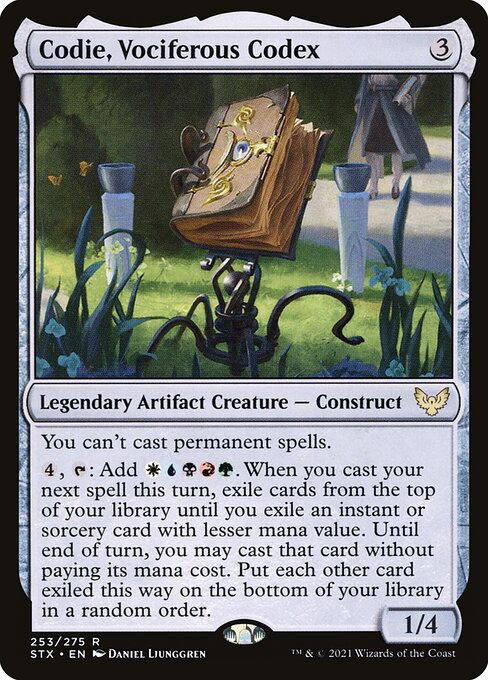
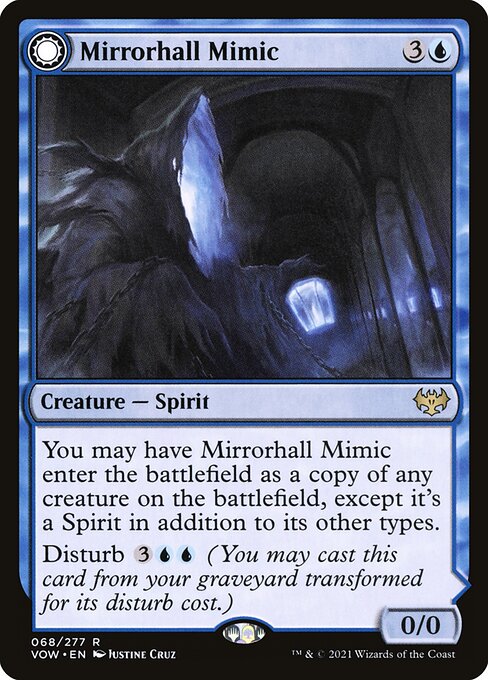
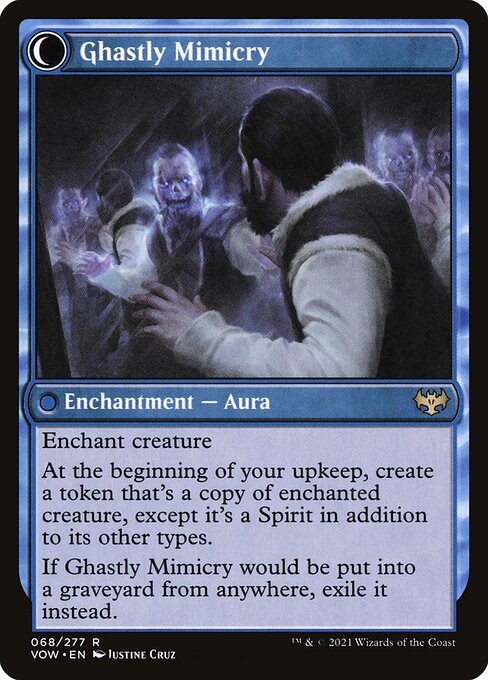
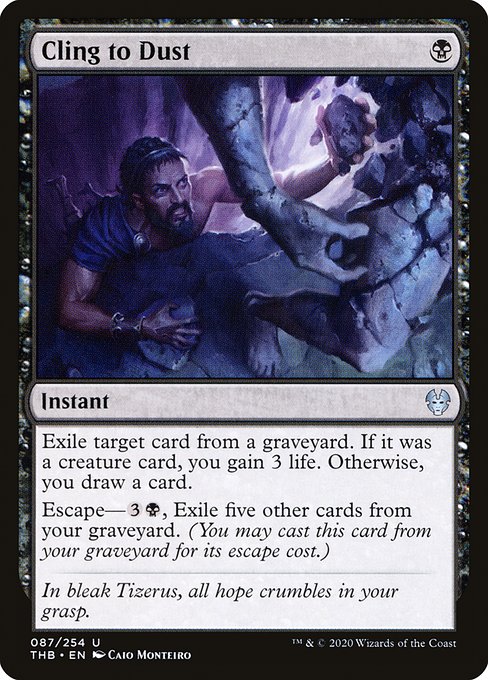
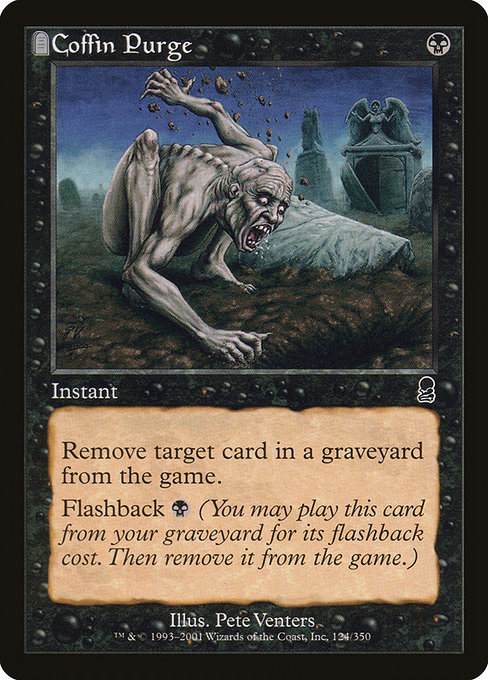
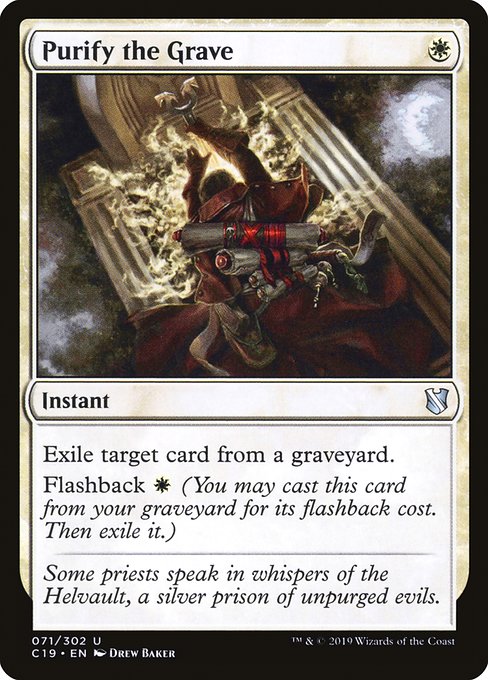
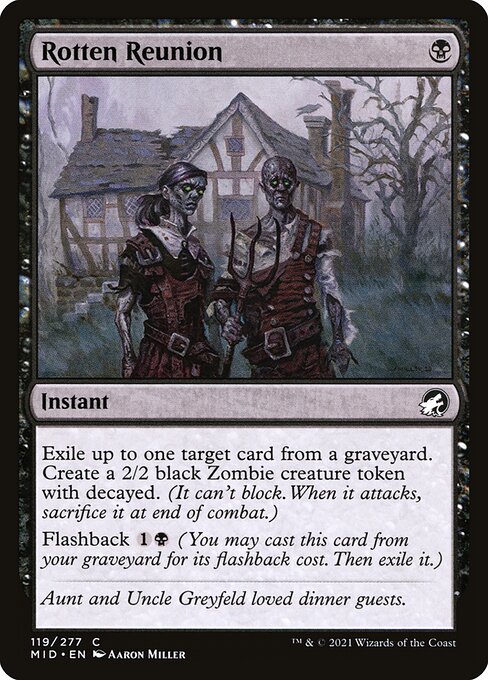
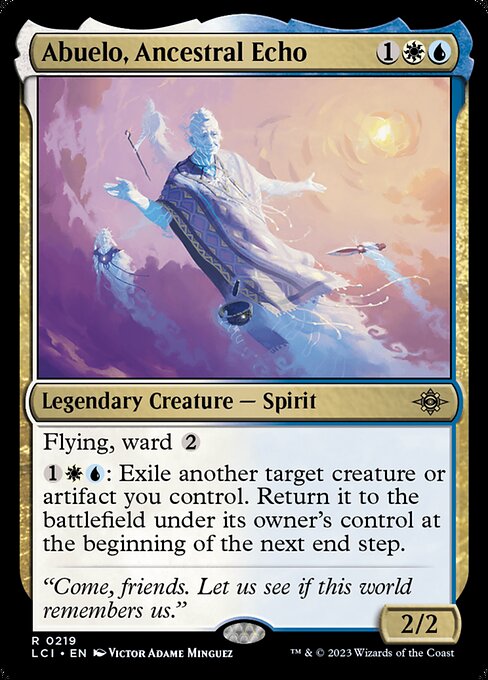
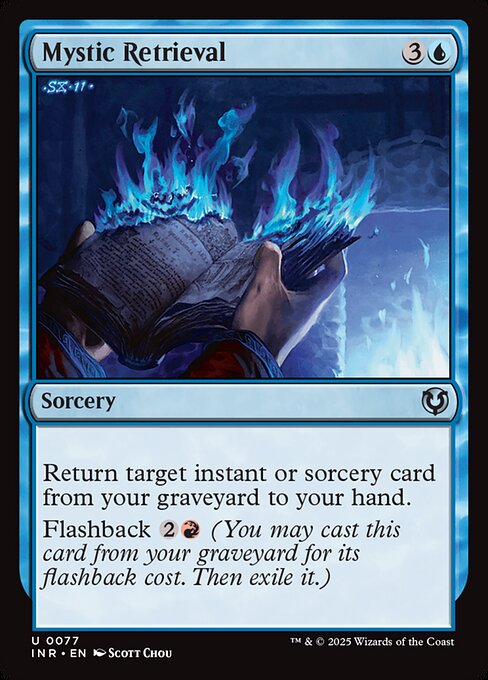
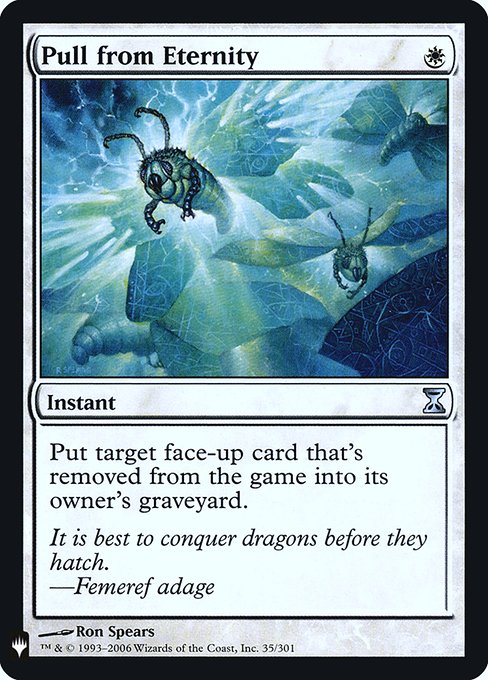
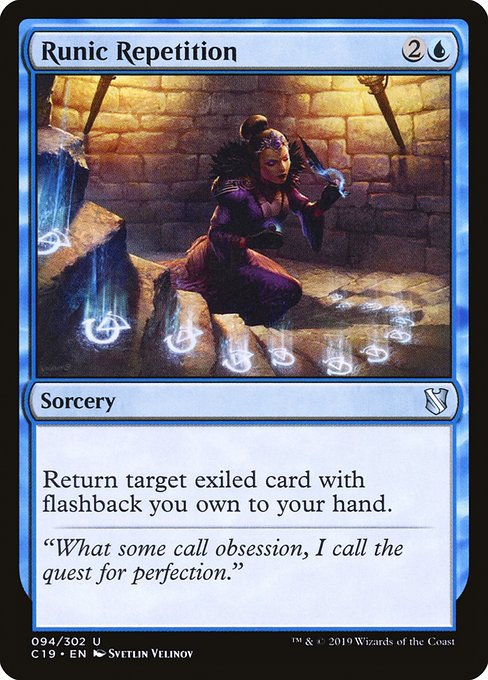
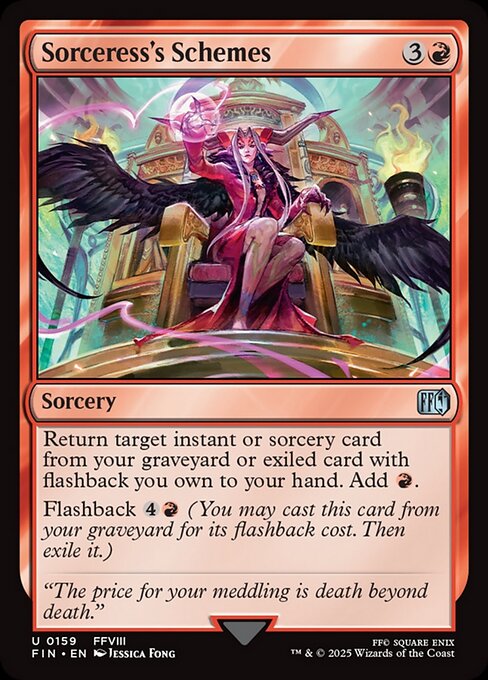
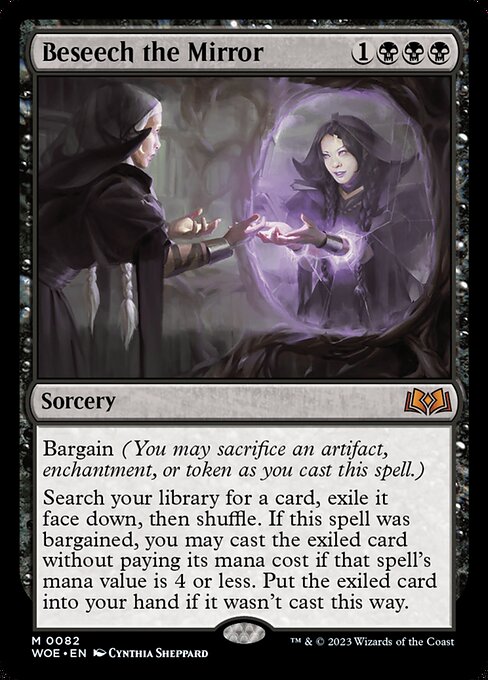
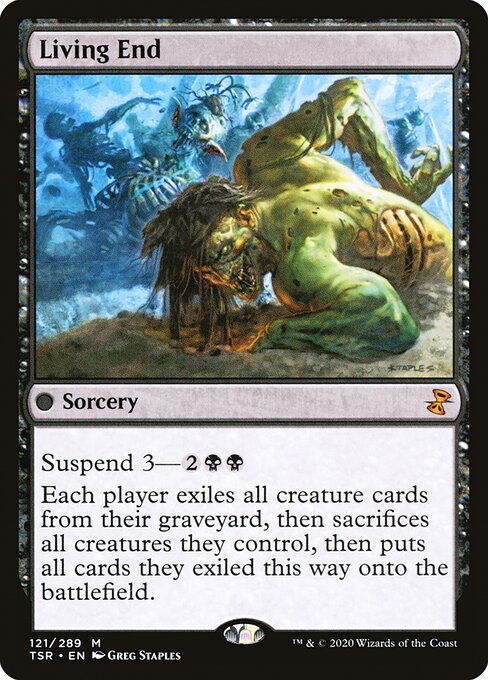
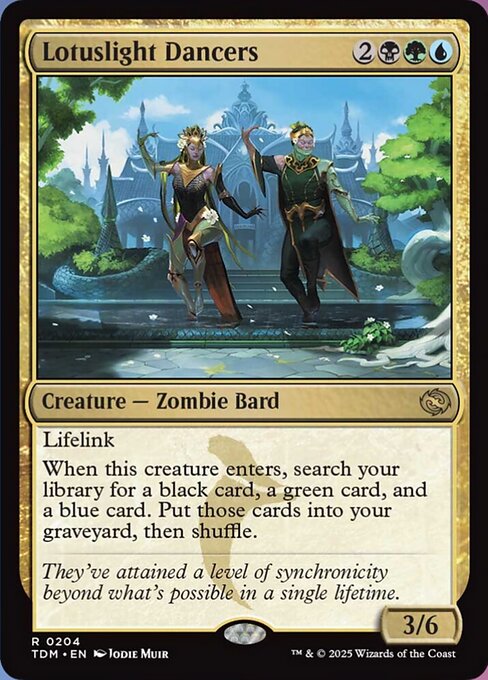
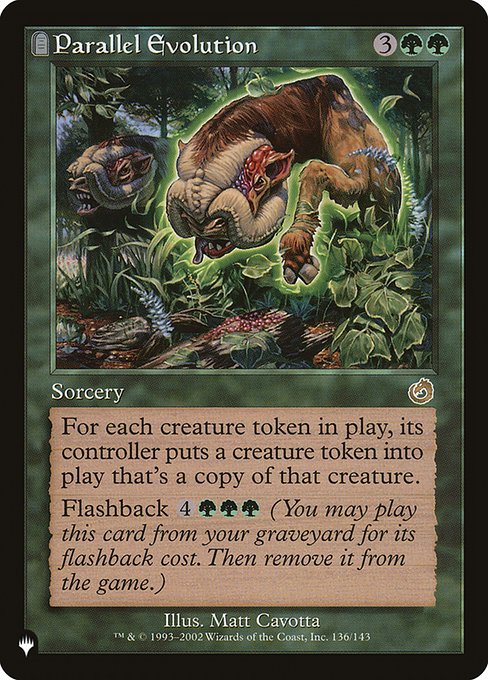
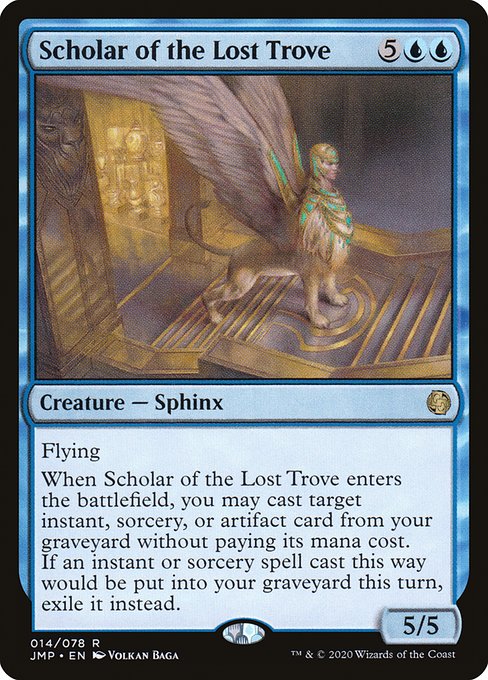
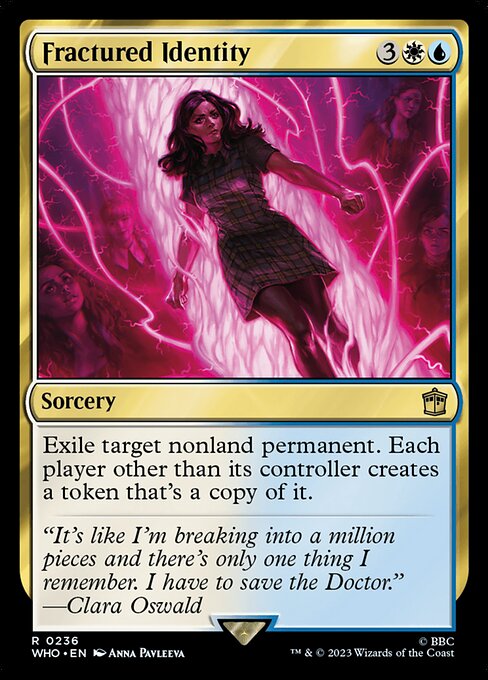
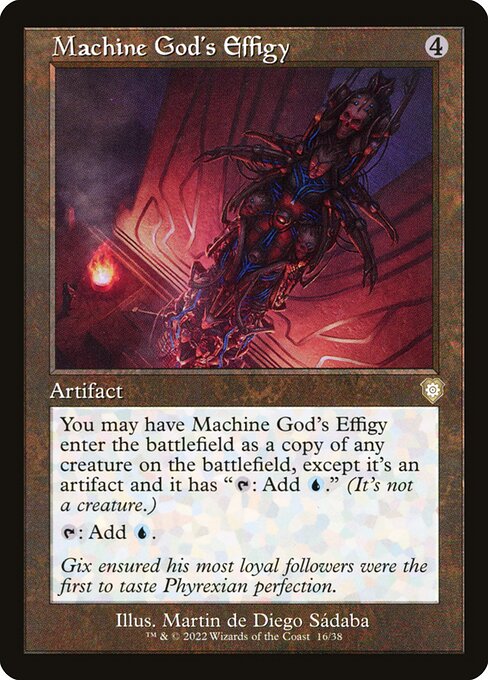
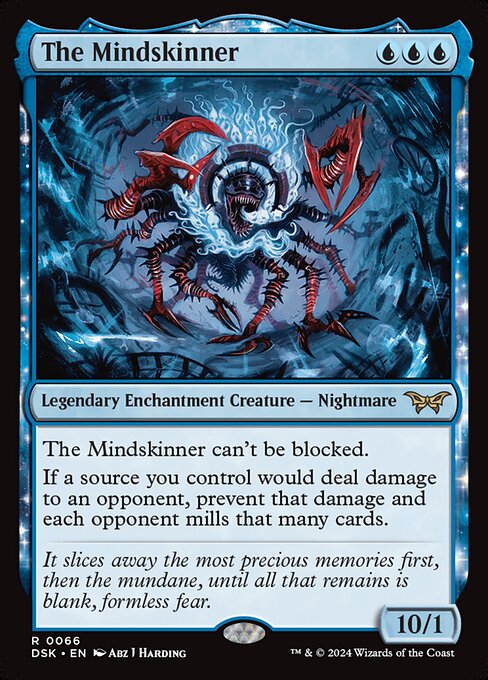
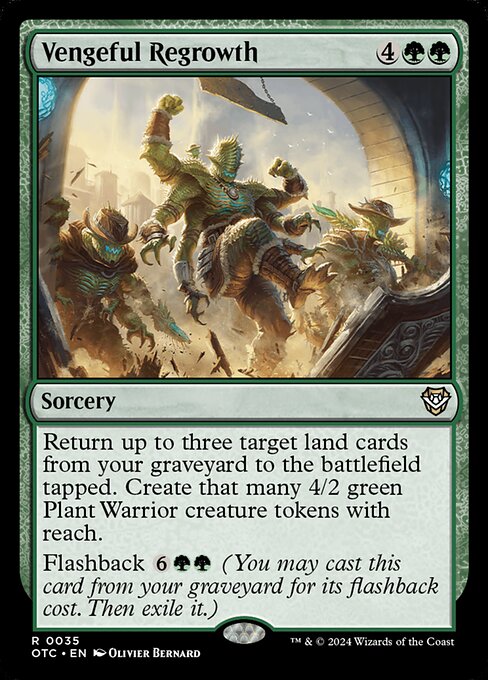
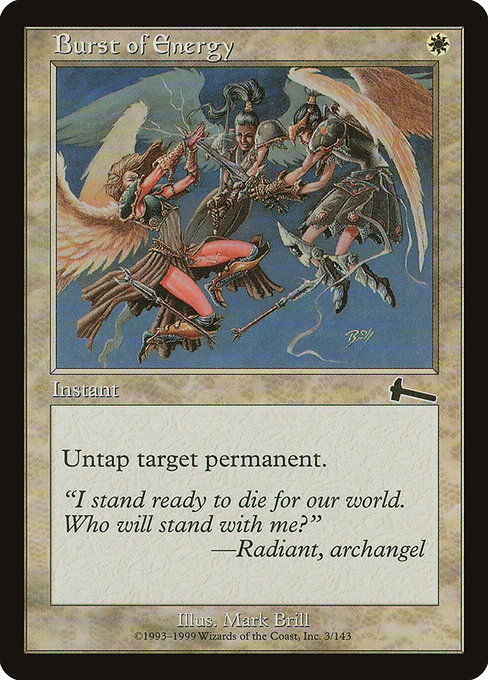
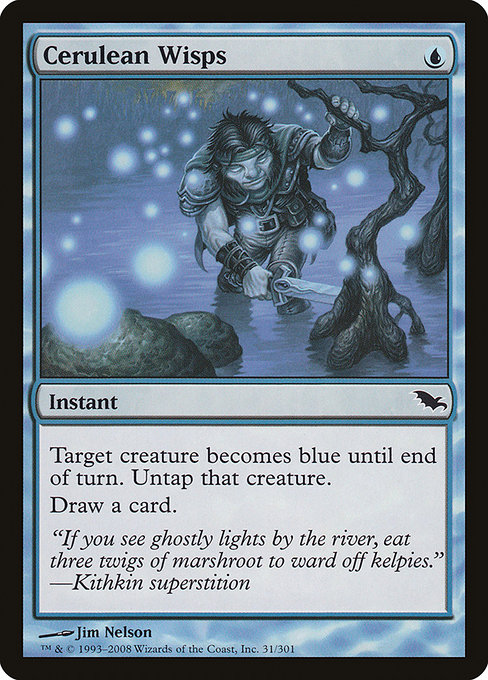
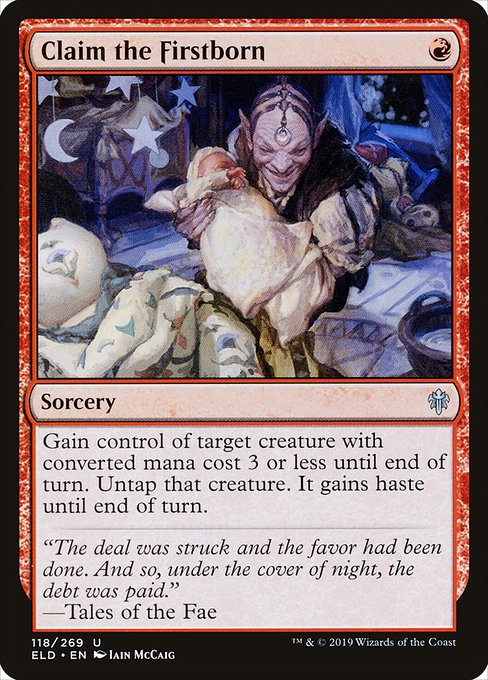
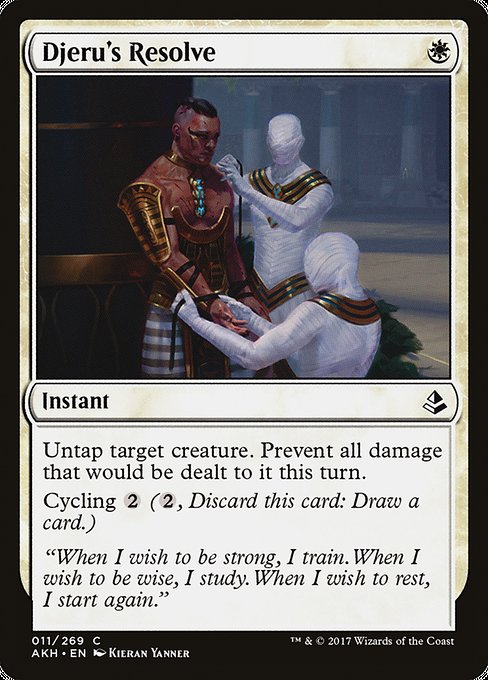
{"ops":[{"insert":"This deck began as a simple observation. Putting "},{"insert":{"card-link":"Assault Suit"}},{"insert":" on "},{"insert":{"card-link":"The Mindskinner"}},{"insert":", is very funny. Because the replacement effect doesn't just apply to The Mindskinner itself, but to every source the player controls, giving it to an opponent instantly turns their deck into a mill deck. It's a perfect way to turn a game sideways, and make everyone at the table just a little bit confused.\n\nHowever, the astute reader will have noticed that this list does not contain an Assault Suit. That's because, as simple as this core idea is, it's very difficult to actually build a deck around. I've taken a long and winding path to arrive at the list you see before you.\n\nDon't get me wrong, it's fully possible to just put a copy of Assault Suit and a few artifact tutors into a Mindskinner list and call it a day. Indeed, that was where I started when I had this idea. But after playing that version of the deck a few times, I came away a little disappointed. Not because it didn't work, or because it wasn't fun, but because it didn't play out quite the way I wanted it to.\n\nMono-blue has a pretty strong suite of artifact tutors, but not a lot of ways to cheat mana or equip costs. The result is that while it is possible to build a Mindskinner deck that can get the Assault Suit consistently, it's not possible to get it on board and equipped to the Commander before turn 5 at the earliest. More typically, having to hold up mana for counterspells will push that back to turn 6 or 7. That's well into the midgame no matter what power level we're talking about. The Mindskinner's opponents will have somewhere between 30 and 40 cards in deck, and the average life total at the table will likely be somewhere in the high teens. However, the Mindskinner player won't have been milled at all up to this point - they'll still have around 80 cards left - so equipping the assault suit and turning all damage into mill is roughly equivalent to gaining ~60 life. This makes for a solid strategy, and a fun shift to the dynamic of the game as the other players each try to either find a way around the effect, collude with the Mindskinner player to mill out a key rival, or just try to deal so much damage that the effective life gain doesn't matter, but it's not really the transformational effect I envisioned in the first paragraph. For the most part, the Mindskinner's opponents won't be leaning into mill as a win condition, they'll be sitting back, not attacking, and trying to get around it. \n"},{"attributes":{"header":3},"insert":"\n"},{"insert":"The lesson from this first attempt was clear, if I wanted my opponents to actually embrace mill as a gameplan, I would have to give them their Mindskinner much earlier. I first tried out a version of this list with "},{"insert":{"card-link":"Zur the Enchanter"}},{"insert":" at the helm. Zur's effect can tutor up both "},{"insert":{"card-link":"The Mindskinner"}},{"insert":" itself and "},{"insert":{"card-link":"Forge Anew"}},{"insert":", which - combined with "},{"insert":{"card-link":"Entomb"}},{"insert":" effects to put Assault Suit in the graveyard - meant it could get the combo online by turn 5 pretty consistently. But turn 5 still wasn't fast enough. This version of the deck was still down on life and up on cards in deck by the time it came online. I had to go faster.\n\nEnter "},{"insert":{"card-link":"Codie, Vociferous Codex"}},{"insert":". This commander is capable of some truly absurd things, and it turns out one of them is assembling a dumb Mindskinner combo on turn 3. The first version of this deck did this by playing some version of "},{"insert":{"card-link":"Llanowar Elves"}},{"insert":" on turn 1, Codie on turn 2, and then using 1-mana untap spells get "},{"insert":{"card-link":"Resurgent Belief"}},{"insert":", and "},{"insert":{"card-link":"Profane Tutor"}},{"insert":" hanging out in exile, ready to cast. From there, it chained Profane Tutor into "},{"insert":{"card-link":"Gifts Ungiven"}},{"insert":", then chained that into Mindskinner, Forge Anew, and Assault Suit and "},{"insert":{"card-link":"Faithless Looting"}},{"insert":", to get all the first three cards in the graveyard, and finished by casting Resurgent Belief to bring the combo online. Turn 3 was finally fast enough that the Mindskinner felt like a sharp turn rather than a roadblock, and the fact that Codie's chain of tutors and spells pulled more than ten cards out of the deck meant that this version actually started out a bit behind its opponents in the mill race. Unfortunately, this speed presented a new problem: power.\n\nEquipping an Assault Suit onto The Mindskinner doesn't just turn all damage into mill, it also gives each opponent an unblockable 12/3. By turn 5 or 7, even a slower deck will have had enough time to come online, so a 12/3 is unlikely to be the strongest thing on an opponent's board. On turn 3 though, even an aggro list will see its damage output completely overshadowed by The Mindskinner. If each player is committed to mill as a gameplan, then it only makes sense that they would attack with The Mindskinner every turn. If everyone attacks every turn, then The Mindskinner will mill 36 cards from every deck at the table, every turn rotation, and ensure the game is over by turn 5, all by itself. That's not \"turning the other decks at the table into mill decks\". That's just rendering everything they're trying to do completely inconsequential.\n\nSo I pivoted one final time, to the list you see here. Instead of giving each opponent a Mindskinner, it gives them a "},{"insert":{"card-link":"Machine God's Effigy"}},{"insert":". The path to getting there starts out the same as the previous version, with a Llanowar Elf on turn 1, and Codie on turn 2, but it gets much more convoluted from there. The deck still uses 1-mana untap spells to grab 0-mana suspend spells, but Resurgent Belief has been swapped out for "},{"insert":{"card-link":"Living End"}},{"insert":". And instead of Gifts Ungiven, Profane Tutor is now chained into "},{"insert":{"card-link":"Buried Alive"}},{"insert":", which puts "},{"insert":{"card-link":"Lotuslight Dancers"}},{"insert":", "},{"insert":{"card-link":"Scholar of the Lost Trove"}},{"insert":", and "},{"insert":{"card-link":"Calamity, Galloping Inferno"}},{"insert":" in the graveyard. Living End then puts Codie in the graveyard (not the command zone), and brings the three creatures that were Buried Alive back to the battlefield. Scholar's effect is used to recast Buried Alive, putting The Mindskinner (and two other creatures that aren't important right now) into the graveyard, while the Lotuslight effect fetches "},{"insert":{"card-link":"Fractured Identity"}},{"insert":", "},{"insert":{"card-link":"Parallel Evolution"}},{"insert":" , and "},{"insert":{"card-link":"Beseech the Mirror"}},{"insert":", also to the graveyard. Next, the combat step begins, Scholar saddles Calamity, Calamity attacks, and two token copies of Scholar are created, putting two Scholar effects on the stack. The first targets Fractured Identity (it goes on the stack first so it will resolve last), and the second targets Parallel Evolution. When Parallel Evolution resolves, it creates two more copies of scholar, and so two more triggers go on the stack, targeting Beseech the Mirror, and Living End. The stack now has three Scholar triggers on it targeting Living End, Beseech the Mirror, and Fractured Identity, and all that's left is to resolve them in that order. First, Living End is put on the stack, and resolved. This results in Lotuslight, Calamity, Scholar, and all the tokens being sacrificed mid-combat before any damage is dealt, and Codie, The Mindskinner, and whatever other creatures happen to be in the graveyard being returned to the battlefield. Notably, casting Living End twice should leave the opponent's boards more-or-less how they were before the combo. Next, Beseech the Mirror gets put on the stack, and Codie is sacrificed to bargain it. It resolves, fetching Machine God's Effigy, which will become a mana rock with the same text as The Mindskinner. Finally, Fractured Identity is put on the stack, targeting the newly created Mindskinner Effigy, and giving one to each opponent.\n\nFinally, everyone at the table is playing mill.\n\nContingencies"},{"attributes":{"header":2},"insert":"\n"},{"insert":"The core combo of this deck is very convoluted, made up of 11 total cards, all of which need to be tutored out of the deck. This means it won't work as described if any of those core cards end up stuck in hand. For every card except Profane Tutor and Living End, this can be fixed by fetching "},{"insert":{"card-link":"Phantasmagorian"}},{"insert":" with Buried Alive. With any combination of Lotuslight Dancers, Scholar of the Lost Trove, and Calamity, Galloping Inferno in hand, put Phantasmagorian in the graveyard with the first cast of Buried Alive, and then discard the relevant creatures before casting living end. With any of the other cards, fetch Phantasmagorian with the second cast of Buried Alive (when Scholar of the Lost Trove first enters the battlefield, and casts it from the graveyard). Note that if Machine God's Effigy is in hand, once it's discarded, the Scholar trigger that would normally target Beseech the Mirror can now just target the Effigy directly.\n\nIf both The Mindskinner and one of the first three Buried Alive targets end up in hand, again fetch Phantasmagorian with the first Buried Alive, and discard The Mindskinner along with the other relevant creatures. This will mean that The Mindskinner is on the battlefield at the same time as Calamity, Scholar, and Dancers, and gets sacrificed by the second cast of Living End. However, fetching "},{"insert":{"card-link":"Angel of Indemnity"}},{"insert":" with the second cast of Buried Alive will allow The Mindskinner to be reanimated in time for Machine God's Effigy to copy it as normal.\n\nIf Profane Tutor or Living End are drawn, that will delay the combo to turn 4. With Profane Tutor, it can just be suspended on turn 2, cast for free on turn 4 fetching Buried Alive, and everything works as normal from there. If Living End is drawn, play as normal until turn 3, then cast just one 1 mana spell, to get Profane Tutor, and use it to fetch "},{"insert":{"card-link":"Insidious Dreams"}},{"insert":" instead of Buried Alive. Cast Insidious Dreams, discarding any two cards besides Living End to stack Buried Alive on top of the deck with "},{"insert":{"card-link":"Electrodominance"}},{"insert":" just below it, then pass the turn. On turn 4, activate Codie, and cast Buried Alive, which will cascade into the Electrodominance that's now on top of the deck. Resolve the Buried Alive, targeting the same three targets as normal, cast Electrodominace for 0 in order to cast Living End from hand, and continue the combo as normal from there.\n"},{"attributes":{"header":2},"insert":"\n"},{"insert":"Power Level"},{"attributes":{"header":2},"insert":"\n"},{"insert":"I've marked this deck as bracket 3, but that probably feels pretty hard to credit when I just walked through how the deck is designed to consistently cast 30+ mana worth of free spells on turn 3. Indeed, this deck is a bit hard to pin down to a specific bracket. It's got a bit of bracket 1 philosophy in that the deck isn't technically trying to win until after all the other decks at the table have been transformed into mill decks (otherwise it would be better to just reanimate and swing with Calamity on turn 3, rather than going through with the rest of the combo), and a whole lot of bracket 4 power turned toward that decidedly silly goal. These oddities mean that playing this deck will always require its opponents be given more information than a simple bracket number, but ultimately it is designed to collapse back down to a bracket 3 power level once its setup is complete. Past turn three Codie will usually not be on board anymore, and there are no more suspend cards to cascade into anyway. Living End has been exiled forever, and all the deck's most powerful creatures are stuck in the graveyard. Basically all the deck's resources have been spent on giving everyone a Mindskinner Effigy, and there isn't a lot left in the tank.\n\nHowever, the attentive reader will not have forgotten about the two arbitrary creatures that were reanimated alongside the Mindskinner on turn 3. Those are going to be two very powerful creatures that will put the deck way too far ahead right? Well, yes and no. In most games the strongest options will be "},{"insert":{"card-link":"Angel of Indemnity"}},{"insert":" and "},{"insert":{"card-link":"Abuelo, Ancestral Echo"}},{"insert":". The Angel's effect will only able to grab a land when it first enters, often making up for a lost "},{"insert":{"card-link":"City of Traitors"}},{"insert":" or "},{"insert":{"card-link":"Hickory Woodlot"}},{"insert":" rather than actually ramping. These creatures form a strong and resilient engine for reanimating 4-cost and lower permanents, but that 4-cost limit means they can't bring back any truly game-ending threats. Noteably, all of the deck's reanimation effects are either similarly limited by mana cost, or return cards to hand rather than the battlefield, so Calamity, Galloping Inferno and Scholar of the Lost Trove will be stuck in the graveyard for quite a while after they've done their job.\n\nIn terms of damage, the deck can keep up, but it's not going to be able to mill out the table by itself. On turn 4, the deck will typically swing for 17 damage, perhaps a bit ahead of the curve for a bracket 3 deck. But remember: 10 of that damage is The Mindskinner - perhaps the most boltable creature ever printed - and a core part of the deck's gameplan is giving all its opponents an extra mana rock. In practice, it ends up being pretty comparable to the competition.\n\nStill, just being at around the right power level doesn't mean that this deck will fit in at any and all bracket 3 tables. For one thing, with every attack milling three players, games with this deck will often be over much faster than a typical commander game. For another, any voltron strategy, or any commander that relies on dealing damage to players to trigger their effects, will be completely shut out of the game by this deck's gimmick. On the other side, any deck with quick and consistent access to artifact removal can completely invalidate that gimmick. Some artifact removal is fine of course - the fact that the Mindskinner Effigies can be removed is just another opportunity for the game to be transformed - but this deck will work best, and be most fun to play both with and against, if the other players are at least mostly OK with playing its game, and aren't going to be trying too hard to remove their Mindskinner Effigies.\n\nLosing to Mill"},{"attributes":{"header":2},"insert":"\n"},{"insert":"One important point with this deck is that it does not run "},{"insert":{"card-link":"Gaea's Blessing"}},{"insert":" or "},{"insert":{"card-link":"Ulamog, the Infinite Gyre"}},{"insert":". It doesn't even have any more limited \"shuffle into library\" effects like "},{"insert":{"card-link":"Krosan Reclamation"}},{"insert":". It absolutely can lose to being milled out, and the fact that it can lose this way is very important to how it plays. If the deck couldn't lose to mill, its opponents would have to look for another way to win, which would usually just mean that they wouldn't deal any damage until they can turn off the Mindskinner effect, just like with the first version of the list.\n\nThe Gameplan Past Turn 3"},{"attributes":{"header":2},"insert":"\n"},{"insert":"Most of the cards in this deck were chosen to make the turn 3 combo as consistent as possible. The deck has 38 lands, 11 turn one ramp spells, 24 one-mana spells intended to cascade into a suspend spell on turn three, and another 14 dedicated to the combo itself. That leaves only 12 cards that will be truly impactful past turn 3. That really shouldn't be enough. Outside these 12 cards, this deck doesn't really have any card draw, so it can't expect to see more than 15-20 cards in the average game (including the opening hand). That would mean only 2-3 of those 12 cards will even be drawn naturally, meaning this deck should run out of meaningful game actions by turn 6. Even if a miracle occurred and all 12 were lined up at the top of the deck, if the deck ever starts casting more than one spell per turn, it will end up burning through all 12 cards somewhere around turn 10. So for this deck to function at all, those 12 cards need to be playable without being drawn, at least somewhat recursive, and highly impactful.\n\nSo, problem the first: how can the deck expect to play these cards if it can't rely on drawing them? Well for starters, two of them are Angel of Indemnity and Abuelo, Ancestral Echo - the two creatures that get tutored up and reanimated alongside The Mindskinner. Because the deck can grab a protection spell with the second cast of Profane Tutor, it can generally rely on having these two creatures available for most of the game.\n\nBut what about the other 10 cards? How can the deck expect to ever see any of them? Well, fortunately, the deck's opponents are all playing mill, so it can count its graveyard being filled even without any card slots dedicated to that task. It can therefor also count on pretty consistent access to any cards that can be cast from the graveyard, or reanimated by Angel of Indemnity. So that's the first and most difficult hurdle cleared: so long as those 10 cards can be cast from the graveyard, they can be cast without being drawn.\n\nProblem the second: 10 cards isn't enough for a whole game's worth of turns. The solution here is recursion, and the key card is "},{"insert":{"card-link":"Sorceress's Schemes"}},{"insert":". In line with the first requirement, it can be cast from the graveyard, and allows for any other flashback card to be re-used twice. That's a good start, but now the deck needs a way to re-use Sorceress's Schemes. Unfortunately, effects that return cards from exile are pretty scarce, and Sorceress's Schemes is the only one that can be cast from the graveyard. The next best option is "},{"insert":{"card-link":"Runic Repetition"}},{"insert":", which can at least be targeted by Sorceress's Schemes. With both cards in the graveyard, Schemes can move Repetition from graveyard to hand, which can then return Schemes from exile to hand, which can then be cast on an arbitrary target, returning to the initial state with both recursion spells in the graveyard, but with an additional arbitrary card returned to hand from graveyard or exile. That's a total of 12 mana spent (though the final cast of Sorceress's Schemes does leave 1 floating red mana) just to return 1 card to hand. So, not a terribly efficient loop, but it can at least be repeated indefinitely. Do also note that in actual gameplay, it will be somewhat important to always have a recursion spell in hand to provide resiliency against graveyard hate. \n\nIn theory, these two spells are enough to solve the deck's problem of running out of spells in the late game all on their own. In practice, they need a bit more help. Even with every opponent playing mill, there's no guarentee that both cards will be in the graveyard at the same time. And if those were the only recursion spells in the deck, then having one without the other would be useless. Runic Repetition can't innately be cast from the graveyard, so if Sorceress's Schemes targeted anything other than Runic Repetition on the first cast (or if either card was exiled from the graveyard before the other got milled), then the loop would be shut off. Fortunately, there are two more cards that can form a similar recursive loop with either Sorceress's Schemes or Runic Repitition: "},{"insert":{"card-link":"Mystic Retrieval"}},{"insert":" and "},{"insert":{"card-link":"Dryad's Revival"}},{"insert":". And with both of these cards added to the deck, that solves the issue of the deck running out of cards.\n\nHowever, it also adds a new problem. As touched on earlier, this is a very mana intensive solution, so now the deck suddenly needs a robust ramp suite to meet its mana needs in the end game. Angel of Indemnity can be used to reanimate lands, which goes at least partway to solving this issue, but even if the combo of Angel and Abuelo is designed to be hard to remove, it's probably not wise to rely on entirely. As such, both "},{"insert":{"card-link":"Sevinne's Reclamation"}},{"insert":" and "},{"insert":{"card-link":"Vengeful Regrowth"}},{"insert":" were included as reasonably impactful cards are also - either optionally or incidentally - strong ramp effects, and "},{"insert":{"card-link":"Binding the Old Gods"}},{"insert":" was added to provide both flexible removal and ramp in a single reanimation target.\n\nThat leaves just 3 slots left, and so far the deck contains only a single removal option. With so few slots left to fill out the deck's removal suite, each card needs to be as flexible as possible. Functionally, this means having the text \"exile target permanent\". "},{"insert":{"card-link":"Canoptek Tomb Sentinel"}},{"insert":" and "},{"insert":{"card-link":"Rite of Oblivion"}},{"insert":" are the only two cards with that text that can be cast from the graveyard, and together with Binding the Old Gods, they give the deck just enough removal for it to function.\n\nThe last of the 12 cards is intended a bit of a failsafe. Even if the deck has failed to put together a strong enough mana base to make effective use of its recursion, and has nothing on board, "},{"insert":{"card-link":"Mirrorhall Mimic // Ghastly Mimicry"}},{"insert":" can still be cast from the graveyard, targeting an opponent's creature, and creating a persistent stream of threats.\n\nGraveyard Hate"},{"attributes":{"header":2},"insert":"\n"},{"insert":"Because every deck at the table will be a mill deck, every graveyard will be very well stocked. This is part of what makes this deck function, and especially what lets it squeeze everything it wants to do after turn 3 into such a small number of deck slots. However, it also gives a huge advantage to opposing graveyard focused decks, and so this deck needs a way to mitigate that advantage.\n\nUltimately, this task falls to 4 cards very similar cards: "},{"insert":{"card-link":"Cling to Dust"}},{"insert":", "},{"insert":{"card-link":"Rotten Reunion"}},{"insert":", "},{"insert":{"card-link":"Purify the Grave"}},{"insert":", and "},{"insert":{"card-link":"Coffin Purge"}},{"insert":". Each of these cards has a mana value of 1, meaning that they can be used during the combo to cascade into a suspend spell (which means they don't have to take up any of the 12 completely non-combo oriented deck slots), and can be cast from the graveyard at instant speed. Together these 4 cards give the deck a pretty consistent means of disrupting its opponents when they try to make use of their graveyard while taking very little away from its own gameplan.\n"}]}
Commander
Codie, Vociferous Codex
You can't cast permanent spells.
, : Add . When you next cast a spell this turn, exile cards from the top of your library until you exile an instant or sorcery card with lesser mana value. Until end of turn, you may cast that card without paying its mana cost. Put each other card exiled this way on the bottom of your library in a random order.
, : Add . When you next cast a spell this turn, exile cards from the top of your library until you exile an instant or sorcery card with lesser mana value. Until end of turn, you may cast that card without paying its mana cost. Put each other card exiled this way on the bottom of your library in a random order.
Legendary Creature Artifact - Construct Book
Commander
(CTRL to add secondary)
Graveyard Hate
Graveyard Hate
(CTRL to add secondary)
Land


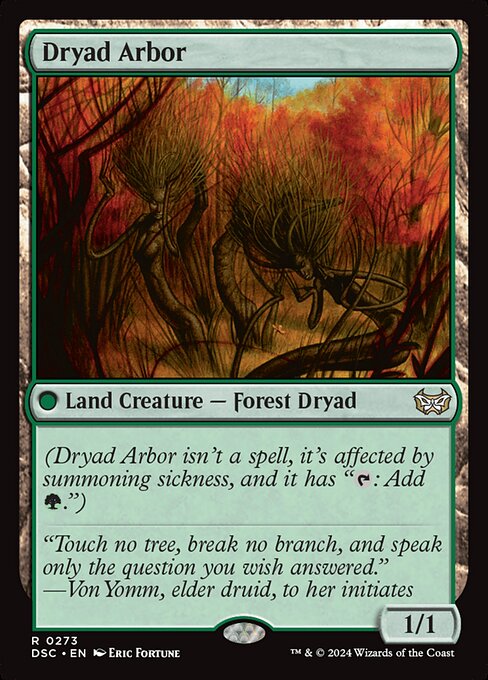
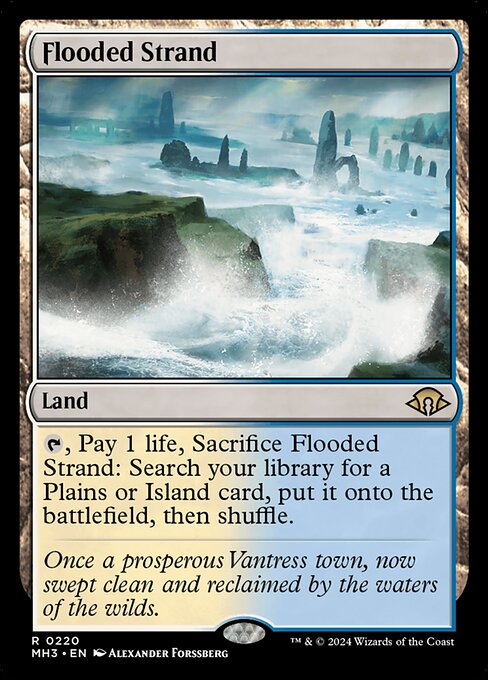
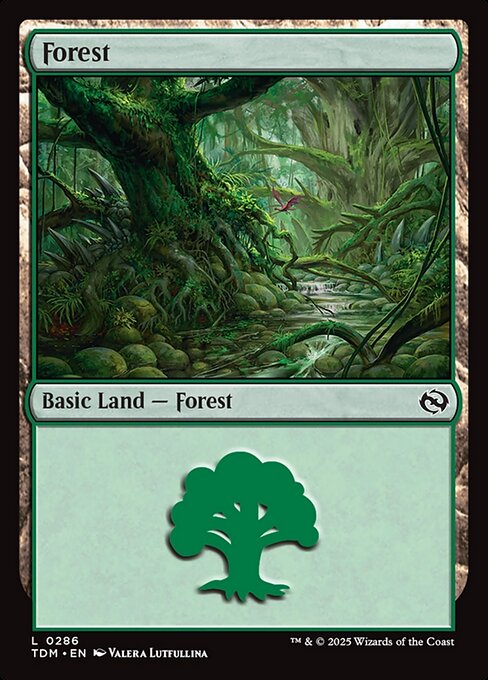
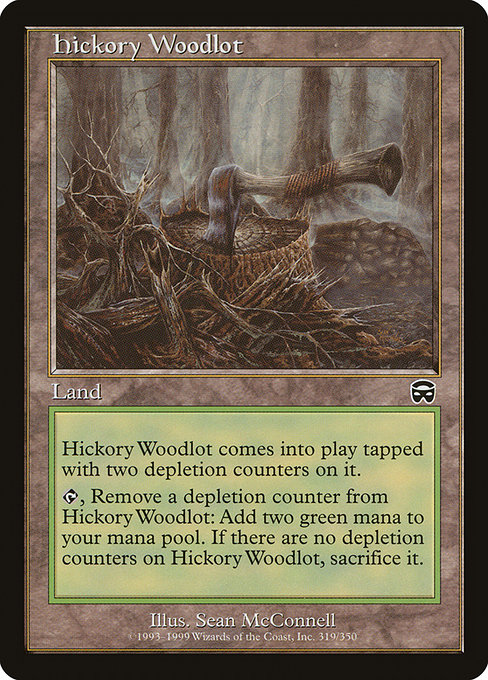
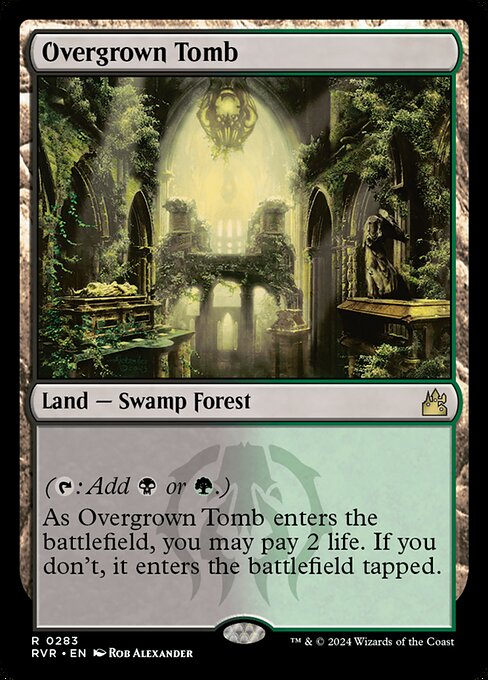
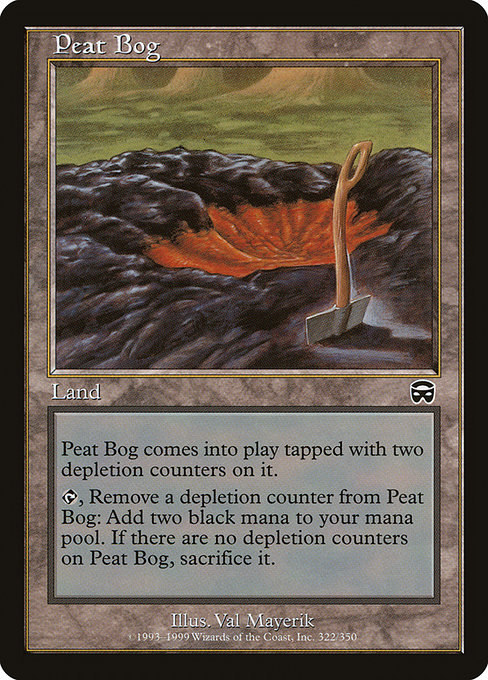
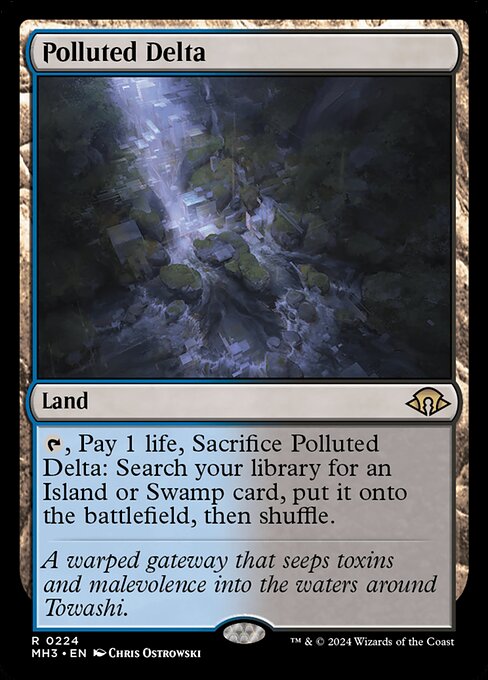
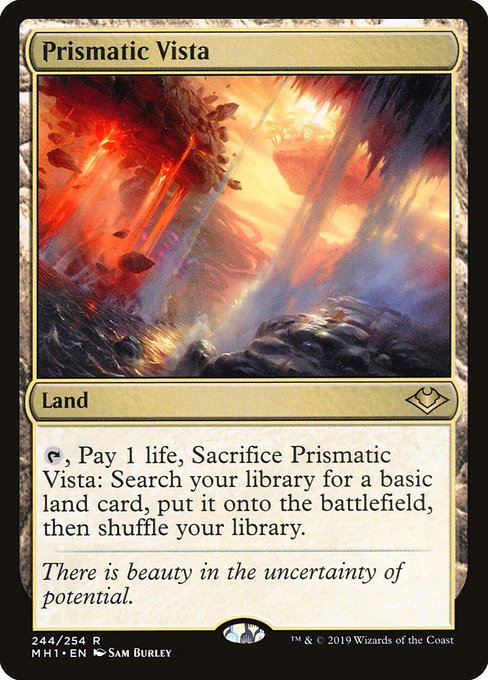
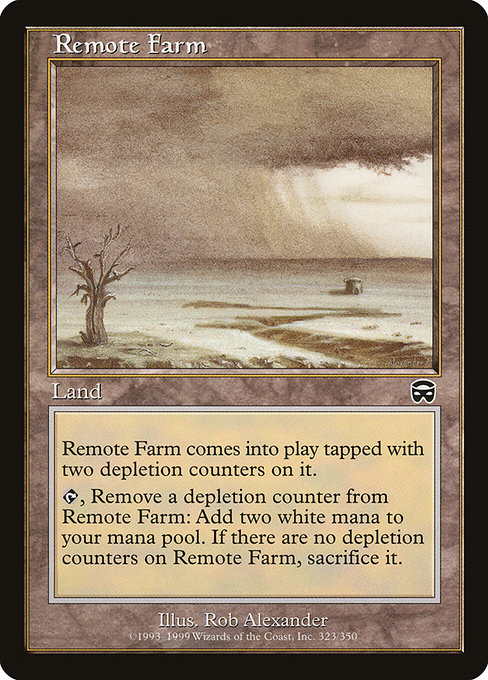
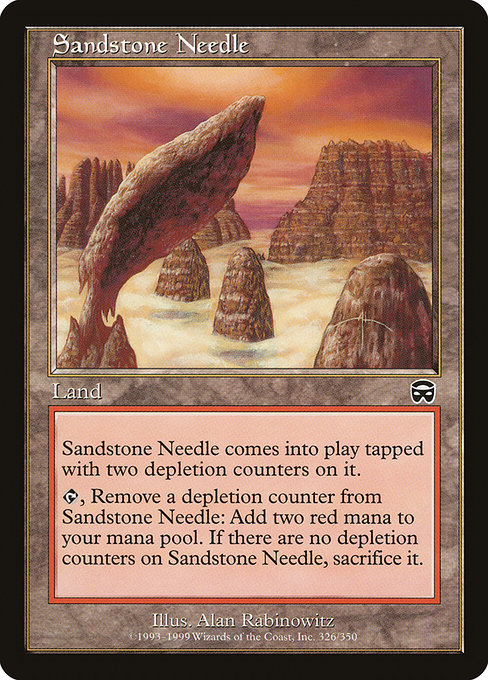
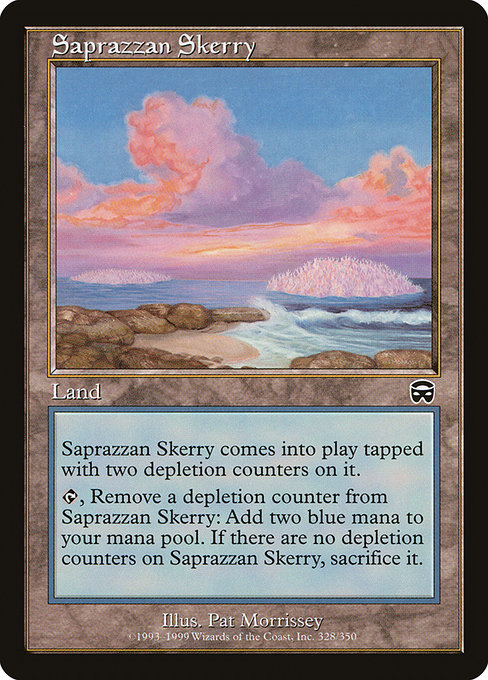
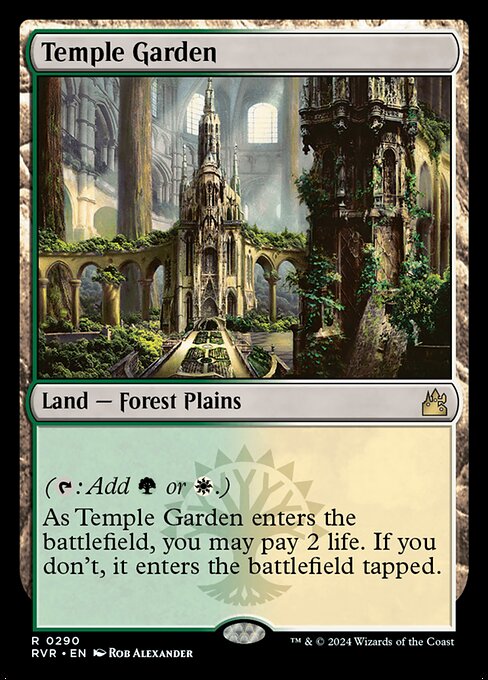
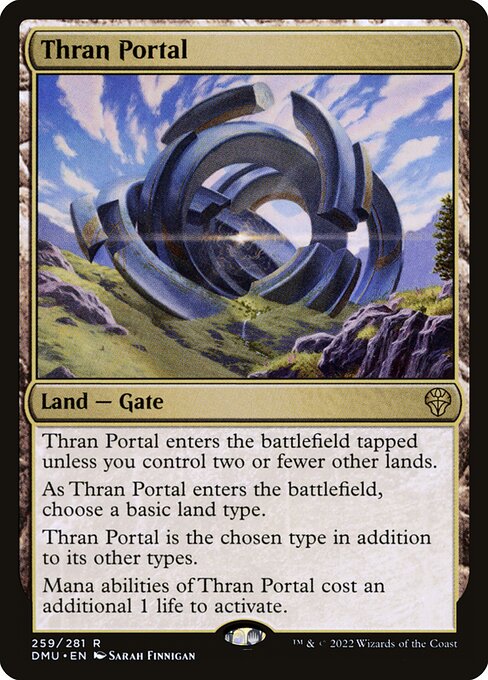
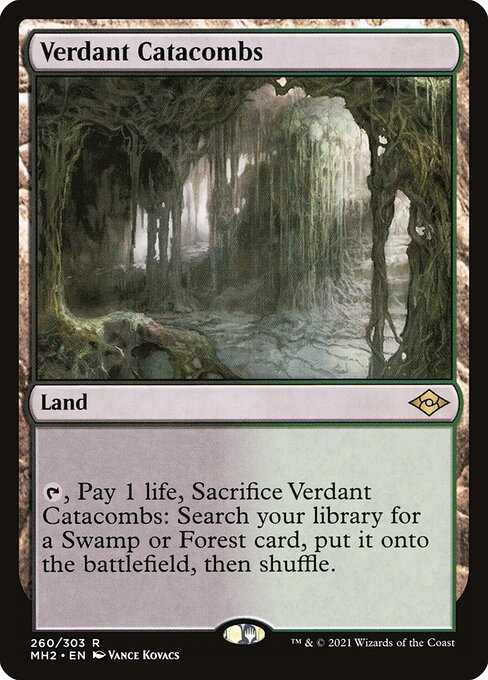
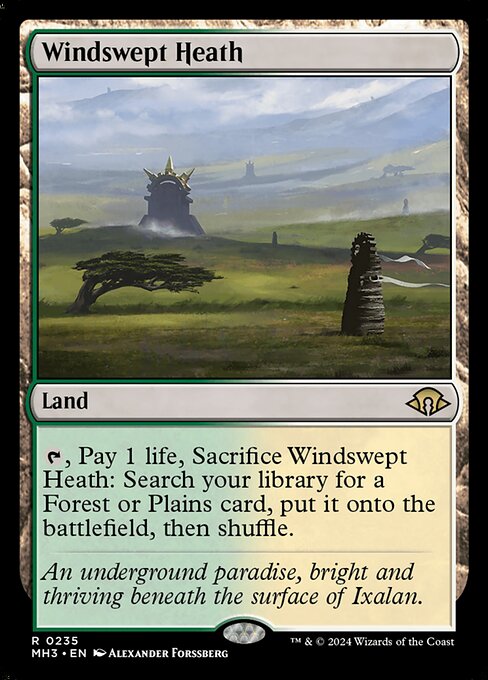
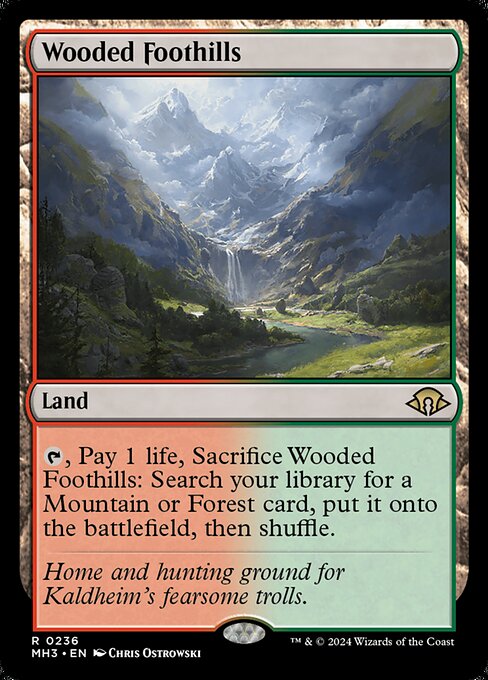
Land
(CTRL to add secondary)
Ramp
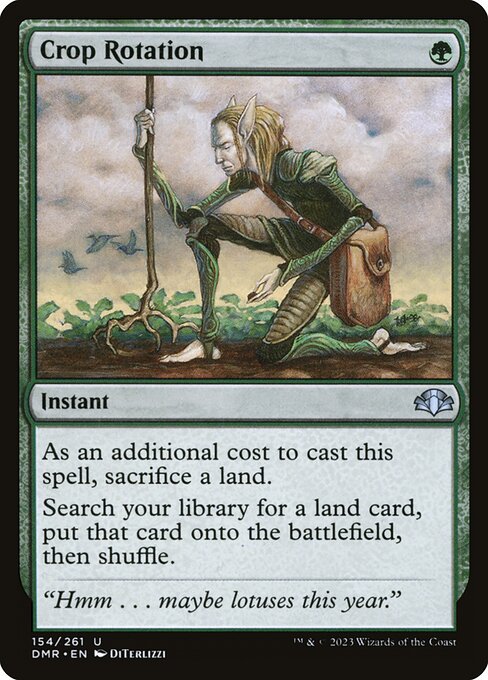
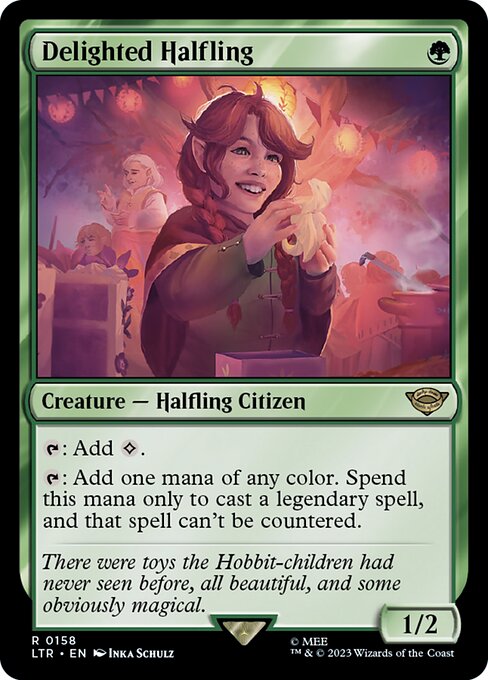
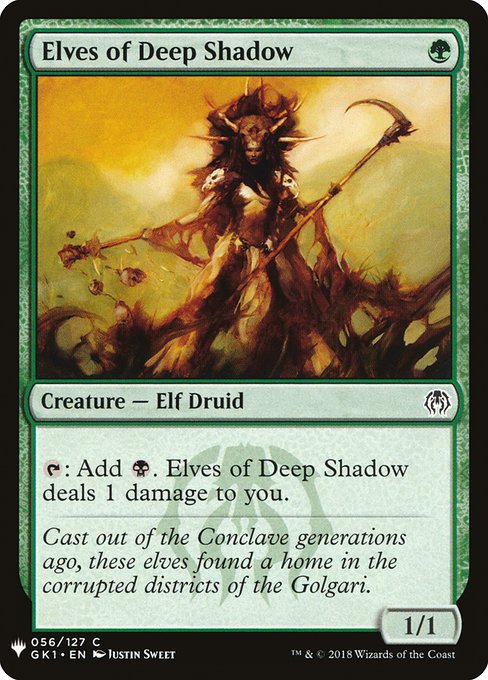
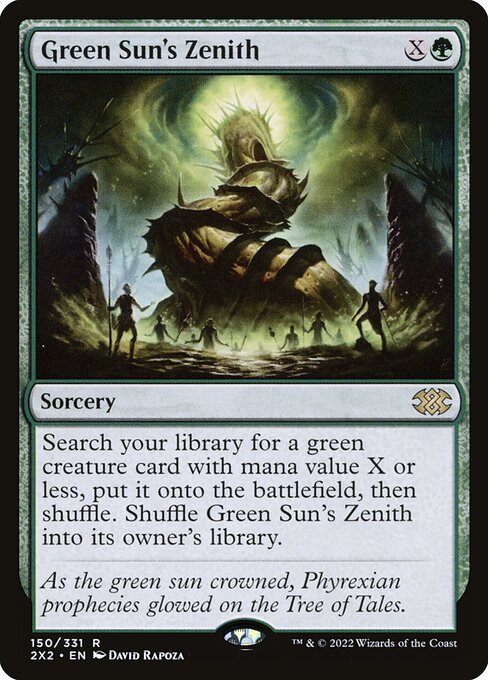
Ramp
(CTRL to add secondary)
Reanimation
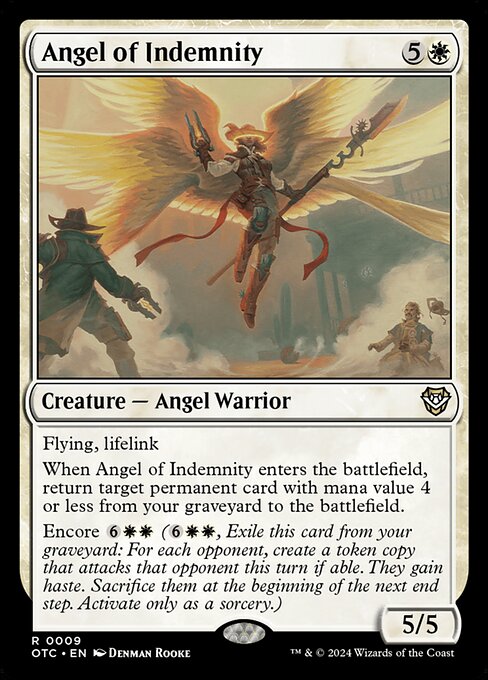
Angel of Indemnity
Flying, lifelink
When this creature enters, return target permanent card with mana value 4 or less from your graveyard to the battlefield.
Encore (, Exile this card from your graveyard: For each opponent, create a token copy that attacks that opponent this turn if able. They gain haste. Sacrifice them at the beginning of the next end step. Activate only as a sorcery.)
When this creature enters, return target permanent card with mana value 4 or less from your graveyard to the battlefield.
Encore (, Exile this card from your graveyard: For each opponent, create a token copy that attacks that opponent this turn if able. They gain haste. Sacrifice them at the beginning of the next end step. Activate only as a sorcery.)
Creature - Warrior Angel
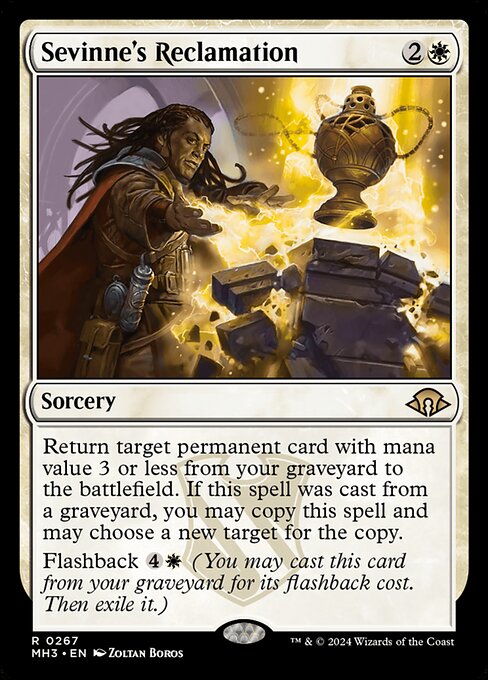
Sevinne's Reclamation
Return target permanent card with mana value 3 or less from your graveyard to the battlefield. If this spell was cast from a graveyard, you may copy this spell and may choose a new target for the copy.
Flashback (You may cast this card from your graveyard for its flashback cost. Then exile it.)
Flashback (You may cast this card from your graveyard for its flashback cost. Then exile it.)
Sorcery
Reanimation
(CTRL to add secondary)
Recursion
Recursion
(CTRL to add secondary)
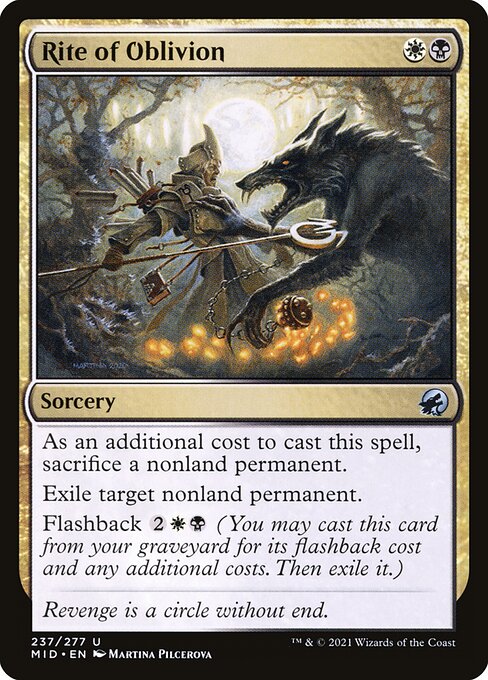
Removal
Binding the Old Gods
(As this Saga enters and after your draw step, add a lore counter. Sacrifice after III.)
I — Destroy target nonland permanent an opponent controls.
II — Search your library for a Forest card, put it onto the battlefield tapped, then shuffle.
III — Creatures you control gain deathtouch until end of turn.
I — Destroy target nonland permanent an opponent controls.
II — Search your library for a Forest card, put it onto the battlefield tapped, then shuffle.
III — Creatures you control gain deathtouch until end of turn.
Enchantment - Saga

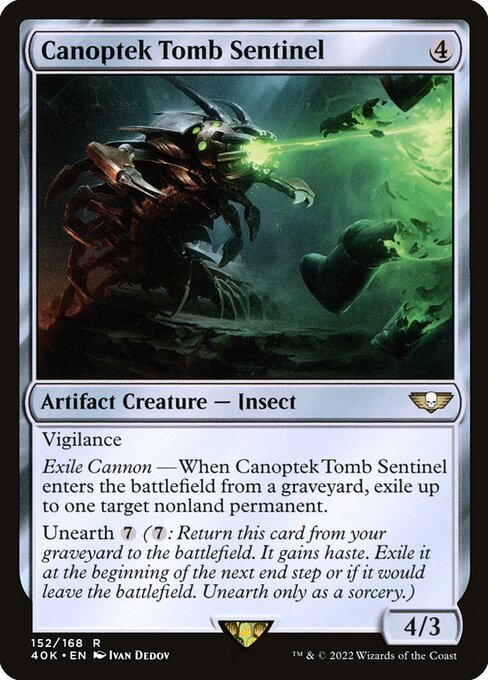
Canoptek Tomb Sentinel
Vigilance
Exile Cannon — When this creature enters from a graveyard, exile up to one target nonland permanent.
Unearth (: Return this card from your graveyard to the battlefield. It gains haste. Exile it at the beginning of the next end step or if it would leave the battlefield. Unearth only as a sorcery.)
Exile Cannon — When this creature enters from a graveyard, exile up to one target nonland permanent.
Unearth (: Return this card from your graveyard to the battlefield. It gains haste. Exile it at the beginning of the next end step or if it would leave the battlefield. Unearth only as a sorcery.)
Creature Artifact - Insect
Removal
(CTRL to add secondary)
Rube Goldberg Contingency

Rube Goldberg Contingency
(CTRL to add secondary)
Rube Goldberg Machine
Beseech the Mirror
Bargain (You may sacrifice an artifact, enchantment, or token as you cast this spell.)
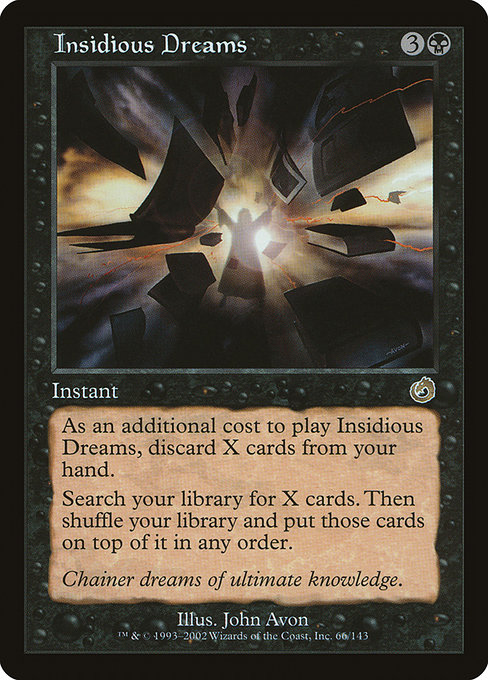
Search your library for a card, exile it face down, then shuffle. If this spell was bargained, you may cast the exiled card without paying its mana cost if that spell's mana value is 4 or less. Put the exiled card into your hand if it wasn't cast this way.
Search your library for a card, exile it face down, then shuffle. If this spell was bargained, you may cast the exiled card without paying its mana cost if that spell's mana value is 4 or less. Put the exiled card into your hand if it wasn't cast this way.
Sorcery
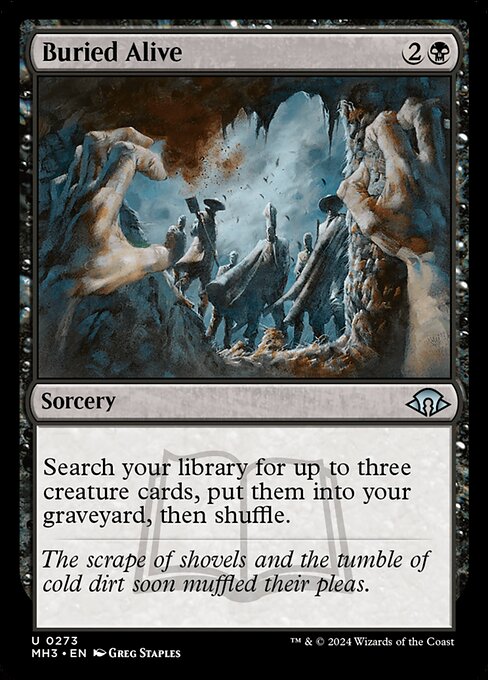
Calamity, Galloping Inferno
Haste
Whenever Calamity attacks while saddled, choose a nonlegendary creature that saddled it this turn and create a tapped and attacking token that's a copy of it. Sacrifice that token at the beginning of the next end step. Repeat this process once.
Saddle 1
Whenever Calamity attacks while saddled, choose a nonlegendary creature that saddled it this turn and create a tapped and attacking token that's a copy of it. Sacrifice that token at the beginning of the next end step. Repeat this process once.
Saddle 1
Legendary Creature - Horse Mount
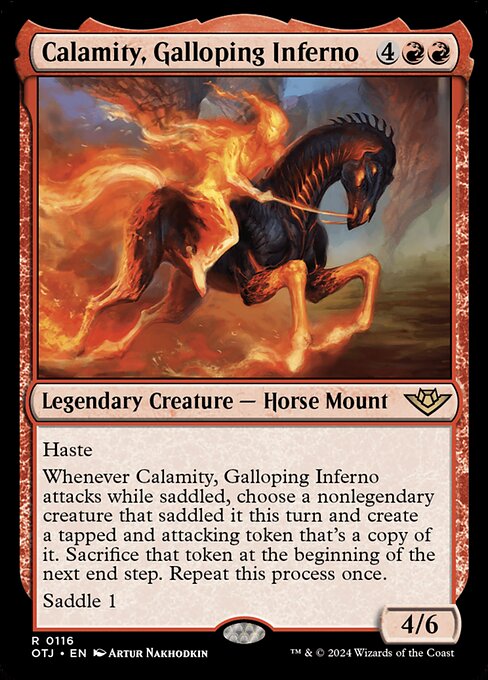
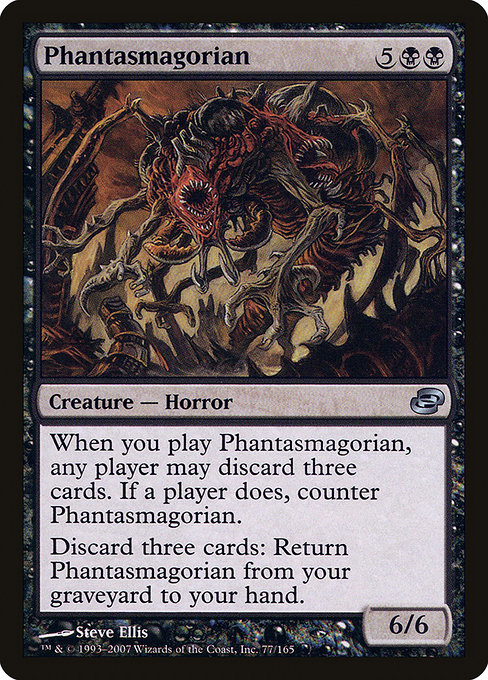
Profane Tutor
Suspend 2— (Rather than cast this card from your hand, pay and exile it with two time counters on it. At the beginning of your upkeep, remove a time counter. When the last is removed, you may cast it without paying its mana cost.)
Search your library for a card, put that card into your hand, then shuffle.
Search your library for a card, put that card into your hand, then shuffle.
Sorcery

Rube Goldberg Machine
(CTRL to add secondary)
Secret Commander
Secret Commander
(CTRL to add secondary)
Tokens
Tokens
(CTRL to add secondary)
Untap
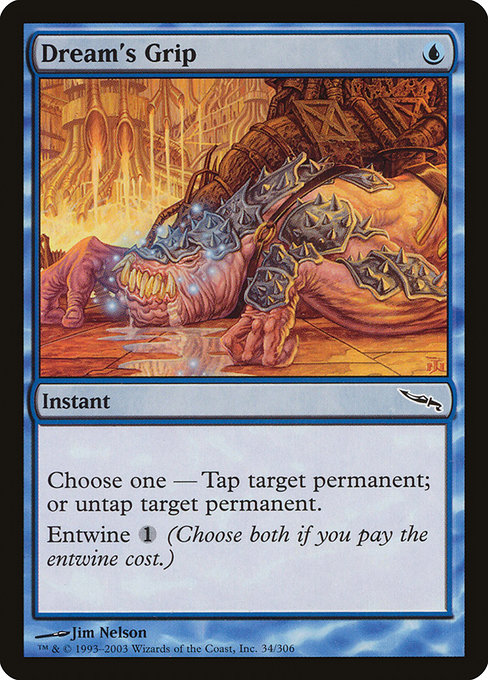
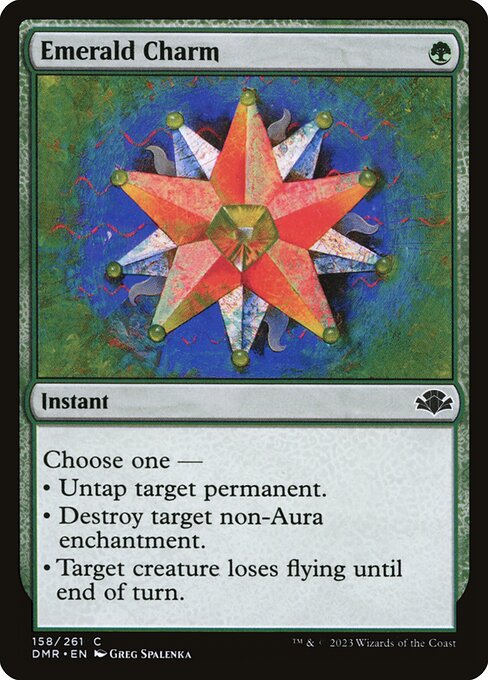
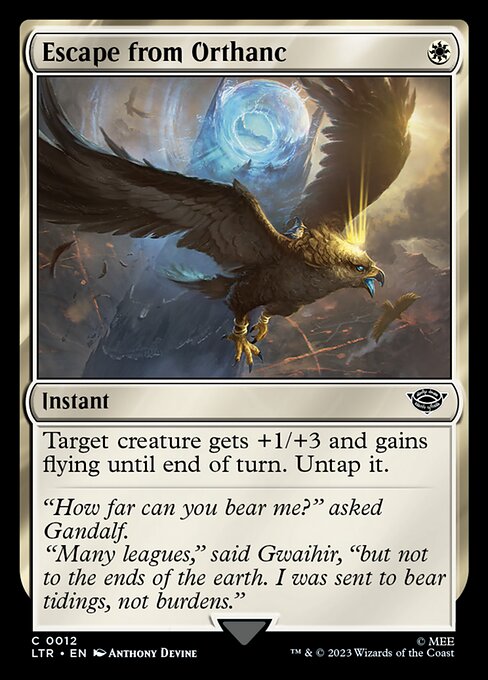
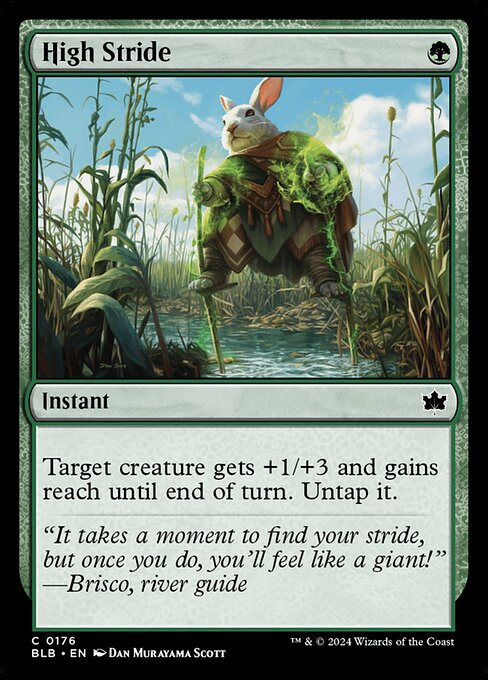
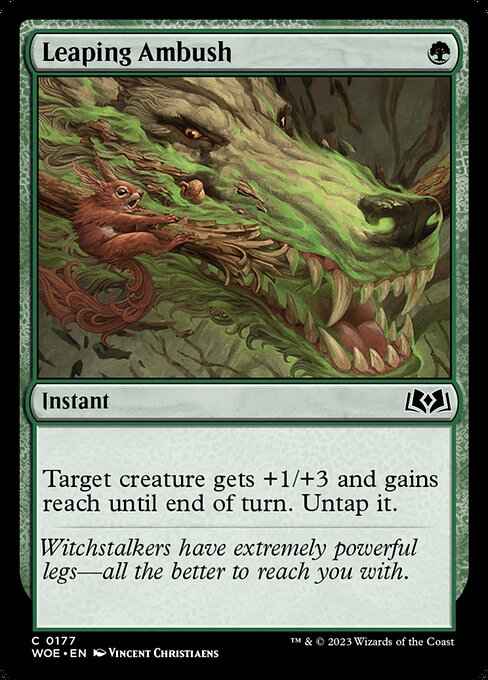
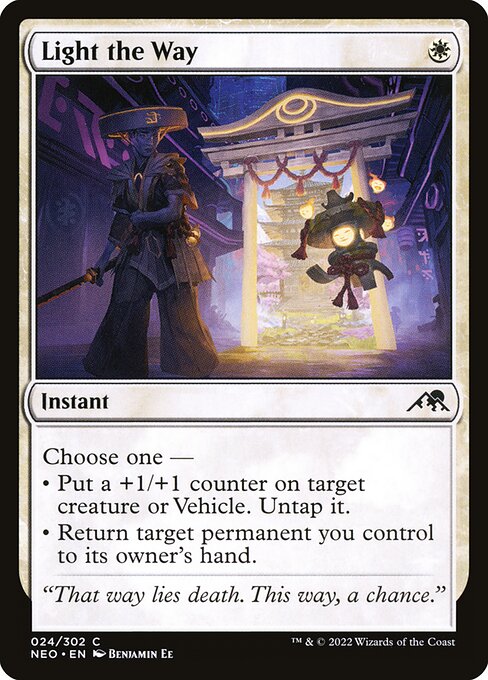
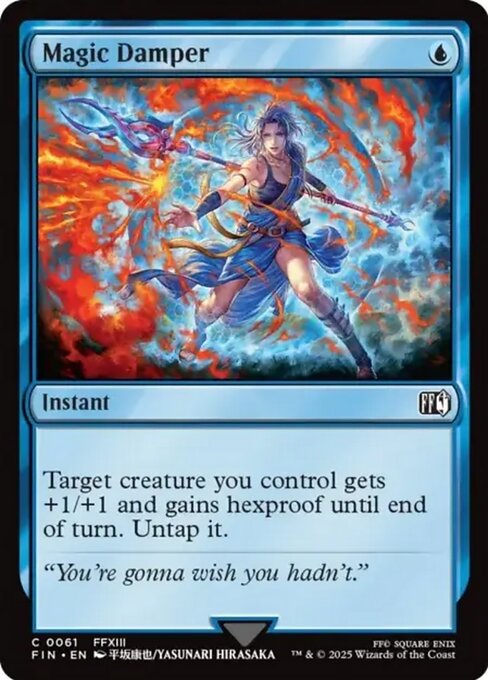
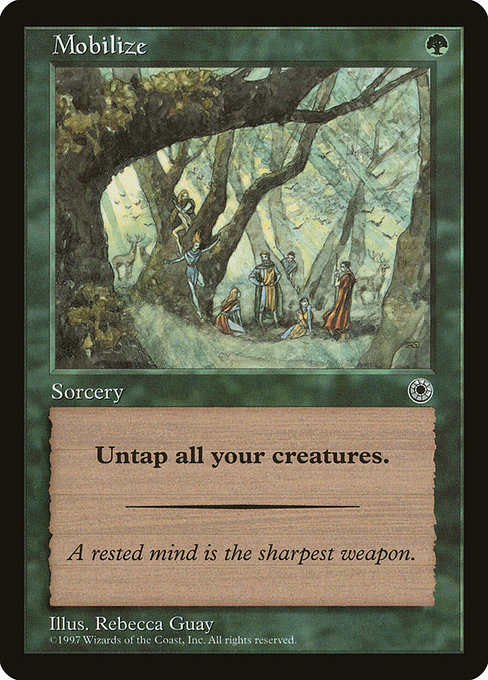
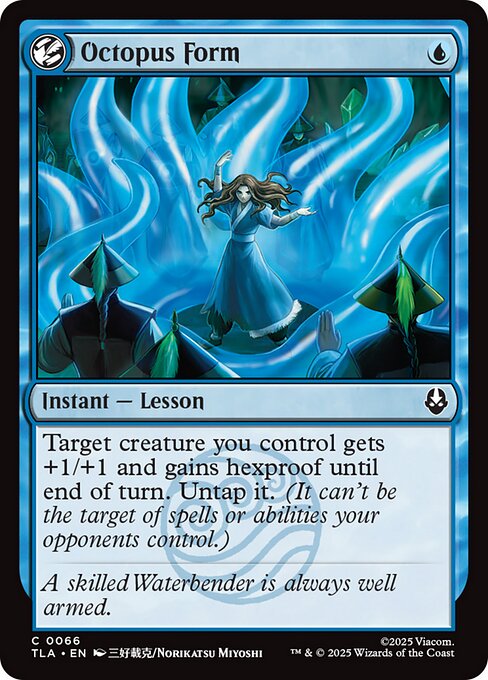
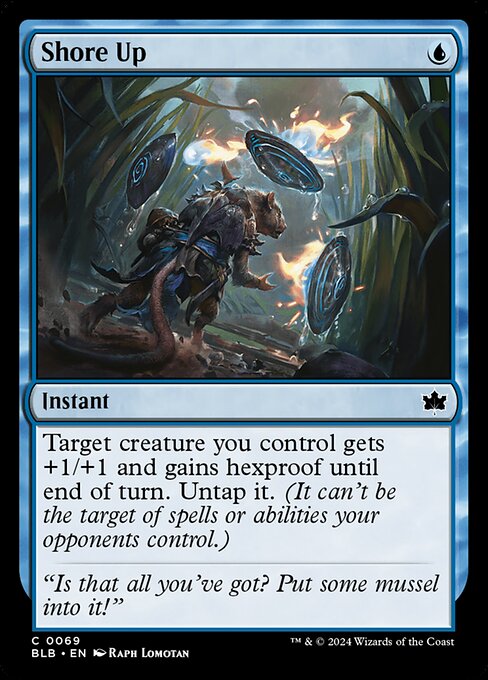
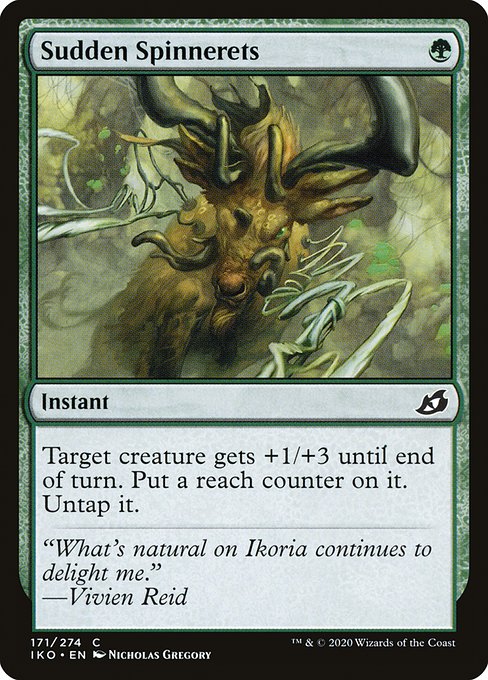
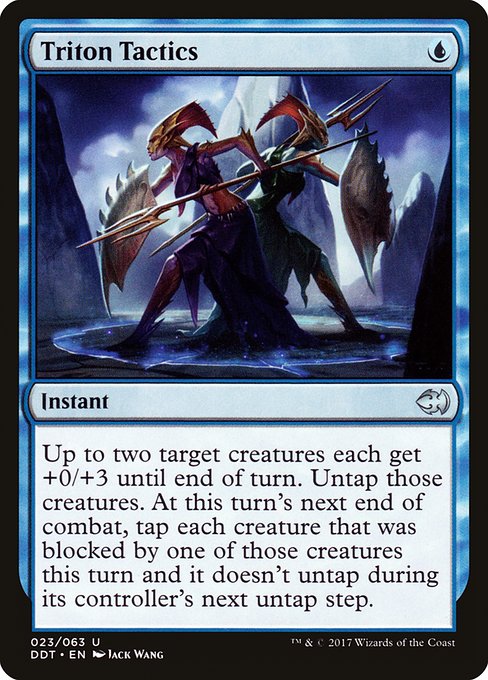
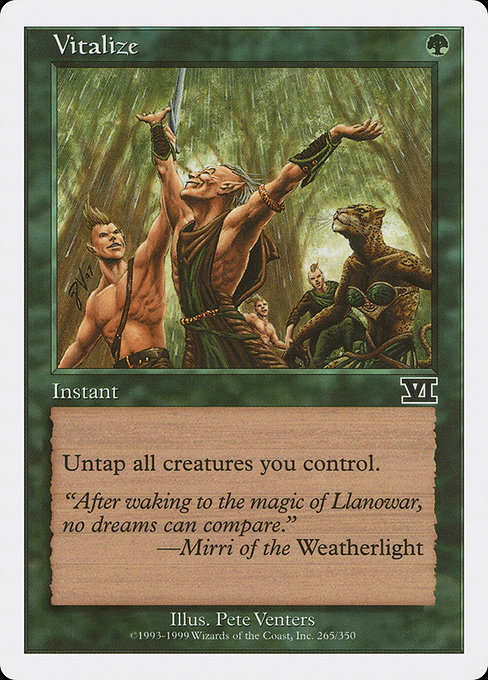
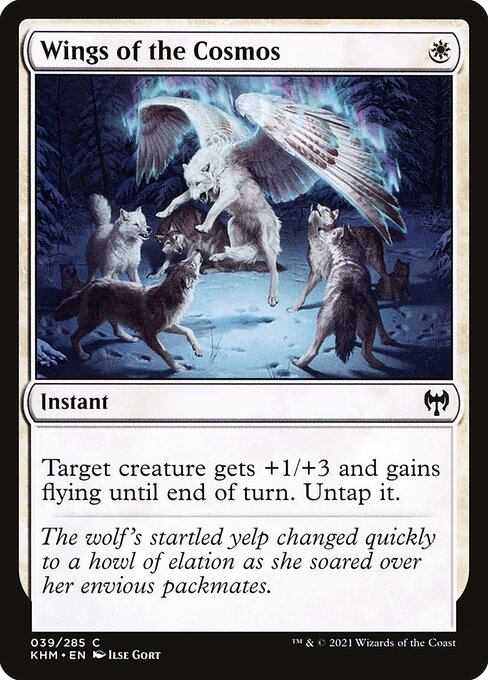
Untap
(CTRL to add secondary)
Deck Info
Deck stats
CategoriesQtyOdds
Click charts to focus on cards
Deck extras (0)
Description
{"ops":[{"insert":"This deck began as a simple observation. Putting "},{"insert":{"card-link":"Assault Suit"}},{"insert":" on "},{"insert":{"card-link":"The Mindskinner"}},{"insert":", is very funny. Because the replacement effect doesn't just apply to The Mindskinner itself, but to every source the player controls, giving it to an opponent instantly turns their deck into a mill deck. It's a perfect way to turn a game sideways, and make everyone at the table just a little bit confused.\n\nHowever, the astute reader will have noticed that this list does not contain an Assault Suit. That's because, as simple as this core idea is, it's very difficult to actually build a deck around. I've taken a long and winding path to arrive at the list you see before you.\n\nDon't get me wrong, it's fully possible to just put a copy of Assault Suit and a few artifact tutors into a Mindskinner list and call it a day. Indeed, that was where I started when I had this idea. But after playing that version of the deck a few times, I came away a little disappointed. Not because it didn't work, or because it wasn't fun, but because it didn't play out quite the way I wanted it to.\n\nMono-blue has a pretty strong suite of artifact tutors, but not a lot of ways to cheat mana or equip costs. The result is that while it is possible to build a Mindskinner deck that can get the Assault Suit consistently, it's not possible to get it on board and equipped to the Commander before turn 5 at the earliest. More typically, having to hold up mana for counterspells will push that back to turn 6 or 7. That's well into the midgame no matter what power level we're talking about. The Mindskinner's opponents will have somewhere between 30 and 40 cards in deck, and the average life total at the table will likely be somewhere in the high teens. However, the Mindskinner player won't have been milled at all up to this point - they'll still have around 80 cards left - so equipping the assault suit and turning all damage into mill is roughly equivalent to gaining ~60 life. This makes for a solid strategy, and a fun shift to the dynamic of the game as the other players each try to either find a way around the effect, collude with the Mindskinner player to mill out a key rival, or just try to deal so much damage that the effective life gain doesn't matter, but it's not really the transformational effect I envisioned in the first paragraph. For the most part, the Mindskinner's opponents won't be leaning into mill as a win condition, they'll be sitting back, not attacking, and trying to get around it. \n"},{"attributes":{"header":3},"insert":"\n"},{"insert":"The lesson from this first attempt was clear, if I wanted my opponents to actually embrace mill as a gameplan, I would have to give them their Mindskinner much earlier. I first tried out a version of this list with "},{"insert":{"card-link":"Zur the Enchanter"}},{"insert":" at the helm. Zur's effect can tutor up both "},{"insert":{"card-link":"The Mindskinner"}},{"insert":" itself and "},{"insert":{"card-link":"Forge Anew"}},{"insert":", which - combined with "},{"insert":{"card-link":"Entomb"}},{"insert":" effects to put Assault Suit in the graveyard - meant it could get the combo online by turn 5 pretty consistently. But turn 5 still wasn't fast enough. This version of the deck was still down on life and up on cards in deck by the time it came online. I had to go faster.\n\nEnter "},{"insert":{"card-link":"Codie, Vociferous Codex"}},{"insert":". This commander is capable of some truly absurd things, and it turns out one of them is assembling a dumb Mindskinner combo on turn 3. The first version of this deck did this by playing some version of "},{"insert":{"card-link":"Llanowar Elves"}},{"insert":" on turn 1, Codie on turn 2, and then using 1-mana untap spells get "},{"insert":{"card-link":"Resurgent Belief"}},{"insert":", and "},{"insert":{"card-link":"Profane Tutor"}},{"insert":" hanging out in exile, ready to cast. From there, it chained Profane Tutor into "},{"insert":{"card-link":"Gifts Ungiven"}},{"insert":", then chained that into Mindskinner, Forge Anew, and Assault Suit and "},{"insert":{"card-link":"Faithless Looting"}},{"insert":", to get all the first three cards in the graveyard, and finished by casting Resurgent Belief to bring the combo online. Turn 3 was finally fast enough that the Mindskinner felt like a sharp turn rather than a roadblock, and the fact that Codie's chain of tutors and spells pulled more than ten cards out of the deck meant that this version actually started out a bit behind its opponents in the mill race. Unfortunately, this speed presented a new problem: power.\n\nEquipping an Assault Suit onto The Mindskinner doesn't just turn all damage into mill, it also gives each opponent an unblockable 12/3. By turn 5 or 7, even a slower deck will have had enough time to come online, so a 12/3 is unlikely to be the strongest thing on an opponent's board. On turn 3 though, even an aggro list will see its damage output completely overshadowed by The Mindskinner. If each player is committed to mill as a gameplan, then it only makes sense that they would attack with The Mindskinner every turn. If everyone attacks every turn, then The Mindskinner will mill 36 cards from every deck at the table, every turn rotation, and ensure the game is over by turn 5, all by itself. That's not \"turning the other decks at the table into mill decks\". That's just rendering everything they're trying to do completely inconsequential.\n\nSo I pivoted one final time, to the list you see here. Instead of giving each opponent a Mindskinner, it gives them a "},{"insert":{"card-link":"Machine God's Effigy"}},{"insert":". The path to getting there starts out the same as the previous version, with a Llanowar Elf on turn 1, and Codie on turn 2, but it gets much more convoluted from there. The deck still uses 1-mana untap spells to grab 0-mana suspend spells, but Resurgent Belief has been swapped out for "},{"insert":{"card-link":"Living End"}},{"insert":". And instead of Gifts Ungiven, Profane Tutor is now chained into "},{"insert":{"card-link":"Buried Alive"}},{"insert":", which puts "},{"insert":{"card-link":"Lotuslight Dancers"}},{"insert":", "},{"insert":{"card-link":"Scholar of the Lost Trove"}},{"insert":", and "},{"insert":{"card-link":"Calamity, Galloping Inferno"}},{"insert":" in the graveyard. Living End then puts Codie in the graveyard (not the command zone), and brings the three creatures that were Buried Alive back to the battlefield. Scholar's effect is used to recast Buried Alive, putting The Mindskinner (and two other creatures that aren't important right now) into the graveyard, while the Lotuslight effect fetches "},{"insert":{"card-link":"Fractured Identity"}},{"insert":", "},{"insert":{"card-link":"Parallel Evolution"}},{"insert":" , and "},{"insert":{"card-link":"Beseech the Mirror"}},{"insert":", also to the graveyard. Next, the combat step begins, Scholar saddles Calamity, Calamity attacks, and two token copies of Scholar are created, putting two Scholar effects on the stack. The first targets Fractured Identity (it goes on the stack first so it will resolve last), and the second targets Parallel Evolution. When Parallel Evolution resolves, it creates two more copies of scholar, and so two more triggers go on the stack, targeting Beseech the Mirror, and Living End. The stack now has three Scholar triggers on it targeting Living End, Beseech the Mirror, and Fractured Identity, and all that's left is to resolve them in that order. First, Living End is put on the stack, and resolved. This results in Lotuslight, Calamity, Scholar, and all the tokens being sacrificed mid-combat before any damage is dealt, and Codie, The Mindskinner, and whatever other creatures happen to be in the graveyard being returned to the battlefield. Notably, casting Living End twice should leave the opponent's boards more-or-less how they were before the combo. Next, Beseech the Mirror gets put on the stack, and Codie is sacrificed to bargain it. It resolves, fetching Machine God's Effigy, which will become a mana rock with the same text as The Mindskinner. Finally, Fractured Identity is put on the stack, targeting the newly created Mindskinner Effigy, and giving one to each opponent.\n\nFinally, everyone at the table is playing mill.\n\nContingencies"},{"attributes":{"header":2},"insert":"\n"},{"insert":"The core combo of this deck is very convoluted, made up of 11 total cards, all of which need to be tutored out of the deck. This means it won't work as described if any of those core cards end up stuck in hand. For every card except Profane Tutor and Living End, this can be fixed by fetching "},{"insert":{"card-link":"Phantasmagorian"}},{"insert":" with Buried Alive. With any combination of Lotuslight Dancers, Scholar of the Lost Trove, and Calamity, Galloping Inferno in hand, put Phantasmagorian in the graveyard with the first cast of Buried Alive, and then discard the relevant creatures before casting living end. With any of the other cards, fetch Phantasmagorian with the second cast of Buried Alive (when Scholar of the Lost Trove first enters the battlefield, and casts it from the graveyard). Note that if Machine God's Effigy is in hand, once it's discarded, the Scholar trigger that would normally target Beseech the Mirror can now just target the Effigy directly.\n\nIf both The Mindskinner and one of the first three Buried Alive targets end up in hand, again fetch Phantasmagorian with the first Buried Alive, and discard The Mindskinner along with the other relevant creatures. This will mean that The Mindskinner is on the battlefield at the same time as Calamity, Scholar, and Dancers, and gets sacrificed by the second cast of Living End. However, fetching "},{"insert":{"card-link":"Angel of Indemnity"}},{"insert":" with the second cast of Buried Alive will allow The Mindskinner to be reanimated in time for Machine God's Effigy to copy it as normal.\n\nIf Profane Tutor or Living End are drawn, that will delay the combo to turn 4. With Profane Tutor, it can just be suspended on turn 2, cast for free on turn 4 fetching Buried Alive, and everything works as normal from there. If Living End is drawn, play as normal until turn 3, then cast just one 1 mana spell, to get Profane Tutor, and use it to fetch "},{"insert":{"card-link":"Insidious Dreams"}},{"insert":" instead of Buried Alive. Cast Insidious Dreams, discarding any two cards besides Living End to stack Buried Alive on top of the deck with "},{"insert":{"card-link":"Electrodominance"}},{"insert":" just below it, then pass the turn. On turn 4, activate Codie, and cast Buried Alive, which will cascade into the Electrodominance that's now on top of the deck. Resolve the Buried Alive, targeting the same three targets as normal, cast Electrodominace for 0 in order to cast Living End from hand, and continue the combo as normal from there.\n"},{"attributes":{"header":2},"insert":"\n"},{"insert":"Power Level"},{"attributes":{"header":2},"insert":"\n"},{"insert":"I've marked this deck as bracket 3, but that probably feels pretty hard to credit when I just walked through how the deck is designed to consistently cast 30+ mana worth of free spells on turn 3. Indeed, this deck is a bit hard to pin down to a specific bracket. It's got a bit of bracket 1 philosophy in that the deck isn't technically trying to win until after all the other decks at the table have been transformed into mill decks (otherwise it would be better to just reanimate and swing with Calamity on turn 3, rather than going through with the rest of the combo), and a whole lot of bracket 4 power turned toward that decidedly silly goal. These oddities mean that playing this deck will always require its opponents be given more information than a simple bracket number, but ultimately it is designed to collapse back down to a bracket 3 power level once its setup is complete. Past turn three Codie will usually not be on board anymore, and there are no more suspend cards to cascade into anyway. Living End has been exiled forever, and all the deck's most powerful creatures are stuck in the graveyard. Basically all the deck's resources have been spent on giving everyone a Mindskinner Effigy, and there isn't a lot left in the tank.\n\nHowever, the attentive reader will not have forgotten about the two arbitrary creatures that were reanimated alongside the Mindskinner on turn 3. Those are going to be two very powerful creatures that will put the deck way too far ahead right? Well, yes and no. In most games the strongest options will be "},{"insert":{"card-link":"Angel of Indemnity"}},{"insert":" and "},{"insert":{"card-link":"Abuelo, Ancestral Echo"}},{"insert":". The Angel's effect will only able to grab a land when it first enters, often making up for a lost "},{"insert":{"card-link":"City of Traitors"}},{"insert":" or "},{"insert":{"card-link":"Hickory Woodlot"}},{"insert":" rather than actually ramping. These creatures form a strong and resilient engine for reanimating 4-cost and lower permanents, but that 4-cost limit means they can't bring back any truly game-ending threats. Noteably, all of the deck's reanimation effects are either similarly limited by mana cost, or return cards to hand rather than the battlefield, so Calamity, Galloping Inferno and Scholar of the Lost Trove will be stuck in the graveyard for quite a while after they've done their job.\n\nIn terms of damage, the deck can keep up, but it's not going to be able to mill out the table by itself. On turn 4, the deck will typically swing for 17 damage, perhaps a bit ahead of the curve for a bracket 3 deck. But remember: 10 of that damage is The Mindskinner - perhaps the most boltable creature ever printed - and a core part of the deck's gameplan is giving all its opponents an extra mana rock. In practice, it ends up being pretty comparable to the competition.\n\nStill, just being at around the right power level doesn't mean that this deck will fit in at any and all bracket 3 tables. For one thing, with every attack milling three players, games with this deck will often be over much faster than a typical commander game. For another, any voltron strategy, or any commander that relies on dealing damage to players to trigger their effects, will be completely shut out of the game by this deck's gimmick. On the other side, any deck with quick and consistent access to artifact removal can completely invalidate that gimmick. Some artifact removal is fine of course - the fact that the Mindskinner Effigies can be removed is just another opportunity for the game to be transformed - but this deck will work best, and be most fun to play both with and against, if the other players are at least mostly OK with playing its game, and aren't going to be trying too hard to remove their Mindskinner Effigies.\n\nLosing to Mill"},{"attributes":{"header":2},"insert":"\n"},{"insert":"One important point with this deck is that it does not run "},{"insert":{"card-link":"Gaea's Blessing"}},{"insert":" or "},{"insert":{"card-link":"Ulamog, the Infinite Gyre"}},{"insert":". It doesn't even have any more limited \"shuffle into library\" effects like "},{"insert":{"card-link":"Krosan Reclamation"}},{"insert":". It absolutely can lose to being milled out, and the fact that it can lose this way is very important to how it plays. If the deck couldn't lose to mill, its opponents would have to look for another way to win, which would usually just mean that they wouldn't deal any damage until they can turn off the Mindskinner effect, just like with the first version of the list.\n\nThe Gameplan Past Turn 3"},{"attributes":{"header":2},"insert":"\n"},{"insert":"Most of the cards in this deck were chosen to make the turn 3 combo as consistent as possible. The deck has 38 lands, 11 turn one ramp spells, 24 one-mana spells intended to cascade into a suspend spell on turn three, and another 14 dedicated to the combo itself. That leaves only 12 cards that will be truly impactful past turn 3. That really shouldn't be enough. Outside these 12 cards, this deck doesn't really have any card draw, so it can't expect to see more than 15-20 cards in the average game (including the opening hand). That would mean only 2-3 of those 12 cards will even be drawn naturally, meaning this deck should run out of meaningful game actions by turn 6. Even if a miracle occurred and all 12 were lined up at the top of the deck, if the deck ever starts casting more than one spell per turn, it will end up burning through all 12 cards somewhere around turn 10. So for this deck to function at all, those 12 cards need to be playable without being drawn, at least somewhat recursive, and highly impactful.\n\nSo, problem the first: how can the deck expect to play these cards if it can't rely on drawing them? Well for starters, two of them are Angel of Indemnity and Abuelo, Ancestral Echo - the two creatures that get tutored up and reanimated alongside The Mindskinner. Because the deck can grab a protection spell with the second cast of Profane Tutor, it can generally rely on having these two creatures available for most of the game.\n\nBut what about the other 10 cards? How can the deck expect to ever see any of them? Well, fortunately, the deck's opponents are all playing mill, so it can count its graveyard being filled even without any card slots dedicated to that task. It can therefor also count on pretty consistent access to any cards that can be cast from the graveyard, or reanimated by Angel of Indemnity. So that's the first and most difficult hurdle cleared: so long as those 10 cards can be cast from the graveyard, they can be cast without being drawn.\n\nProblem the second: 10 cards isn't enough for a whole game's worth of turns. The solution here is recursion, and the key card is "},{"insert":{"card-link":"Sorceress's Schemes"}},{"insert":". In line with the first requirement, it can be cast from the graveyard, and allows for any other flashback card to be re-used twice. That's a good start, but now the deck needs a way to re-use Sorceress's Schemes. Unfortunately, effects that return cards from exile are pretty scarce, and Sorceress's Schemes is the only one that can be cast from the graveyard. The next best option is "},{"insert":{"card-link":"Runic Repetition"}},{"insert":", which can at least be targeted by Sorceress's Schemes. With both cards in the graveyard, Schemes can move Repetition from graveyard to hand, which can then return Schemes from exile to hand, which can then be cast on an arbitrary target, returning to the initial state with both recursion spells in the graveyard, but with an additional arbitrary card returned to hand from graveyard or exile. That's a total of 12 mana spent (though the final cast of Sorceress's Schemes does leave 1 floating red mana) just to return 1 card to hand. So, not a terribly efficient loop, but it can at least be repeated indefinitely. Do also note that in actual gameplay, it will be somewhat important to always have a recursion spell in hand to provide resiliency against graveyard hate. \n\nIn theory, these two spells are enough to solve the deck's problem of running out of spells in the late game all on their own. In practice, they need a bit more help. Even with every opponent playing mill, there's no guarentee that both cards will be in the graveyard at the same time. And if those were the only recursion spells in the deck, then having one without the other would be useless. Runic Repetition can't innately be cast from the graveyard, so if Sorceress's Schemes targeted anything other than Runic Repetition on the first cast (or if either card was exiled from the graveyard before the other got milled), then the loop would be shut off. Fortunately, there are two more cards that can form a similar recursive loop with either Sorceress's Schemes or Runic Repitition: "},{"insert":{"card-link":"Mystic Retrieval"}},{"insert":" and "},{"insert":{"card-link":"Dryad's Revival"}},{"insert":". And with both of these cards added to the deck, that solves the issue of the deck running out of cards.\n\nHowever, it also adds a new problem. As touched on earlier, this is a very mana intensive solution, so now the deck suddenly needs a robust ramp suite to meet its mana needs in the end game. Angel of Indemnity can be used to reanimate lands, which goes at least partway to solving this issue, but even if the combo of Angel and Abuelo is designed to be hard to remove, it's probably not wise to rely on entirely. As such, both "},{"insert":{"card-link":"Sevinne's Reclamation"}},{"insert":" and "},{"insert":{"card-link":"Vengeful Regrowth"}},{"insert":" were included as reasonably impactful cards are also - either optionally or incidentally - strong ramp effects, and "},{"insert":{"card-link":"Binding the Old Gods"}},{"insert":" was added to provide both flexible removal and ramp in a single reanimation target.\n\nThat leaves just 3 slots left, and so far the deck contains only a single removal option. With so few slots left to fill out the deck's removal suite, each card needs to be as flexible as possible. Functionally, this means having the text \"exile target permanent\". "},{"insert":{"card-link":"Canoptek Tomb Sentinel"}},{"insert":" and "},{"insert":{"card-link":"Rite of Oblivion"}},{"insert":" are the only two cards with that text that can be cast from the graveyard, and together with Binding the Old Gods, they give the deck just enough removal for it to function.\n\nThe last of the 12 cards is intended a bit of a failsafe. Even if the deck has failed to put together a strong enough mana base to make effective use of its recursion, and has nothing on board, "},{"insert":{"card-link":"Mirrorhall Mimic // Ghastly Mimicry"}},{"insert":" can still be cast from the graveyard, targeting an opponent's creature, and creating a persistent stream of threats.\n\nGraveyard Hate"},{"attributes":{"header":2},"insert":"\n"},{"insert":"Because every deck at the table will be a mill deck, every graveyard will be very well stocked. This is part of what makes this deck function, and especially what lets it squeeze everything it wants to do after turn 3 into such a small number of deck slots. However, it also gives a huge advantage to opposing graveyard focused decks, and so this deck needs a way to mitigate that advantage.\n\nUltimately, this task falls to 4 cards very similar cards: "},{"insert":{"card-link":"Cling to Dust"}},{"insert":", "},{"insert":{"card-link":"Rotten Reunion"}},{"insert":", "},{"insert":{"card-link":"Purify the Grave"}},{"insert":", and "},{"insert":{"card-link":"Coffin Purge"}},{"insert":". Each of these cards has a mana value of 1, meaning that they can be used during the combo to cascade into a suspend spell (which means they don't have to take up any of the 12 completely non-combo oriented deck slots), and can be cast from the graveyard at instant speed. Together these 4 cards give the deck a pretty consistent means of disrupting its opponents when they try to make use of their graveyard while taking very little away from its own gameplan.\n"}]}